
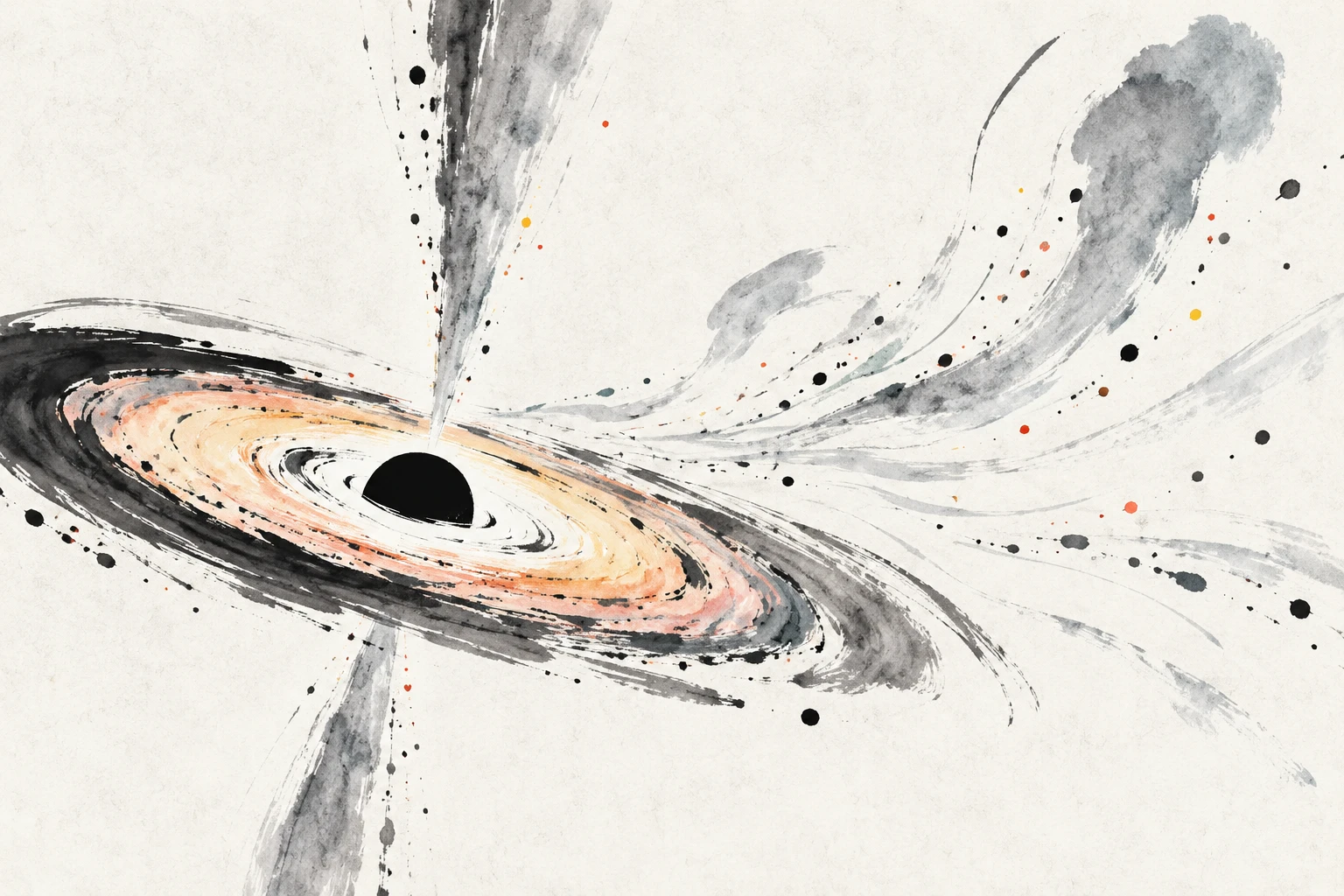
The Same Wind, Two Different Skies: Why Black Hole and Neutron Star Outflows Seem to Vanish
A new review of X-ray binaries finds that accretion disc winds are common around stellar-mass black holes and neutron stars, but their X-ray and optical signatures split across accretion states, suggesting the same wind may be present but changes how it glows with accretion state.
Jan 8, 2026
The Outburst That Blew Itself Out
In 2015, the black hole binary V404 Cygni woke from decades of quiet. Optical spectra caught wind signatures in a dozen lines, then a nebular phase: a cooling, expanding cloud glowing after the X-ray, optical and radio flux dropped. The review cites estimates that the ejected mass was estimated to lie between 10^-8 and 10^-6 solar masses, up to 100 times the mass accreted during the outburst. This was not a minor breeze. It may have stripped enough of the disc to help end the outburst.
A Disc That Feeds and Fights Back
X-ray binaries are natural laboratories for accretion. A low-mass star feeds a black hole or neutron star through an accretion disc. Early theory in 1973 expected strong outflows near the Eddington limit, the luminosity where radiation pressure balances gravity. But firm evidence did not arrive until the 2000s. Since then, winds have been recognized as a common, perhaps ubiquitous, feature of accreting stellar-mass compact objects. The new review, posted as a preprint on arXiv, gathers two decades of observations and theory.
Jets, Winds, and Two Ways to Glow
Outflows in these systems come in two broad classes. Jets are collimated, often relativistic, radio-bright, and carry little mass. Winds are wider, slower, and can carry substantial mass. The review sorts winds by ionization. Low-ionization winds appear in optical, near-infrared, and ultraviolet lines. High-ionization winds appear in X-rays. Both can show P-Cygni profiles, a blueshifted absorption paired with emission, which is a strong sign of gas moving toward the observer.
The State-Dependent Disappearing Act
The central puzzle is why the two views rarely appear together. In black hole transients, high-ionization X-ray winds are detected mostly in the soft state, when the X-ray spectrum is dominated by thermal disc emission. Low-ionization optical and near-infrared winds are detected mostly in the hard state, when a compact radio jet is active. The review compiles 30 systems with confident wind signatures in at least one band. Yet only three have confident detections of both low- and high-ionization winds, and only V404 Cygni has simultaneous high-resolution X-ray and optical spectroscopy.
The split may be about visibility, not absence. A harder X-ray spectrum can heat gas to tens to hundreds of millions of degrees, creating a hot wind that is too ionized to produce optical lines. A softer spectrum can overionize or change the conditions needed for some X-ray absorption. The review notes that low-ionization NIR signatures can persist into the soft state, while X-ray winds can appear alongside jets in some hard or intermediate states. The same outflow may be present in all states but lit differently.
What the Telescopes Measure
The evidence comes from line profiles, not direct images. Blueshifted absorption traces gas moving toward us; broad emission traces gas scattering light from the disc and wind. Chandra and XMM-Newton provided the first secure X-ray blueshifts. XRISM's Resolve spectrometer now offers much sharper X-ray line measurements. Ground-based telescopes such as GTC, VLT, and SALT, plus Hubble and JWST, supply the optical, near-infrared, and ultraviolet view. In the review's confident sample, outflow speeds range from about 200 to 4000 kilometers per second; separate tentative X-ray detections report much higher speeds, up to tens of thousands of kilometers per second, but those remain unconfirmed. The review warns that X-ray velocities are often measured from line centroids, while optical velocities use the blue edge of P-Cygni profiles, so comparisons need care.
An Equatorial, Multiphase Wind
Most confident detections come from systems seen at high orbital inclination, close to edge-on. That supports an equatorial wind, launched from the disc plane. Observations of the precessing disc in Hercules X-1 also point to a wind whose structure changes with viewing angle. In V404 Cygni, X-ray and optical lines show similar speeds, but not always at the same time. That favors a multiphase, clumpy outflow, where dense cold clumps and a hotter, more ionized component coexist. Mass estimates are rough but striking: X-ray winds can carry mass comparable to the accretion rate, sometimes exceeding it by 10 to 20 times, and V404 Cygni's outflow may have been even more extreme.
Where the Wind Still Escapes the Models
Theory has three main engines: radiation pressure, thermal pressure from X-ray heating, and magnetic fields. Thermal models reproduce many X-ray absorption lines in soft states. Magnetic models can explain a wide range of velocities. But cold, fast optical winds in hard states remain difficult, and the large-scale magnetic fields assumed by some models are not yet well justified. The review is an arXiv preprint, and its conclusions rest on an uneven observational record. Many X-ray detections are tentative, mass outflow rates depend on assumed geometry and accretion efficiency, and simultaneous multiwavelength campaigns are rare.
The Next Decade of Wind Watching
XRISM, JWST, new infrared spectrographs, and X-ray polarimetry may finally connect the optical and X-ray faces of the same wind. If they do, the picture could shift from separate state-dependent outflows to one multiphase wind that changes its glow as the accretion flow changes. Either way, the review makes clear that black holes and neutron stars do not merely consume their surroundings. They can also return a significant fraction of that matter to space, shaping the outbursts we see.