
JWST Probes Ten Times Fainter Star-Forming Galaxies at Cosmic Noon
A new JWST/NIRISS survey behind the Abell 2744 cluster measures the Hα luminosity function at z~1.3 and z~2.0, revealing a steep faint-end slope and cosmic star-formation rate densities consistent with the peak near z~2.
Dec 29, 2025
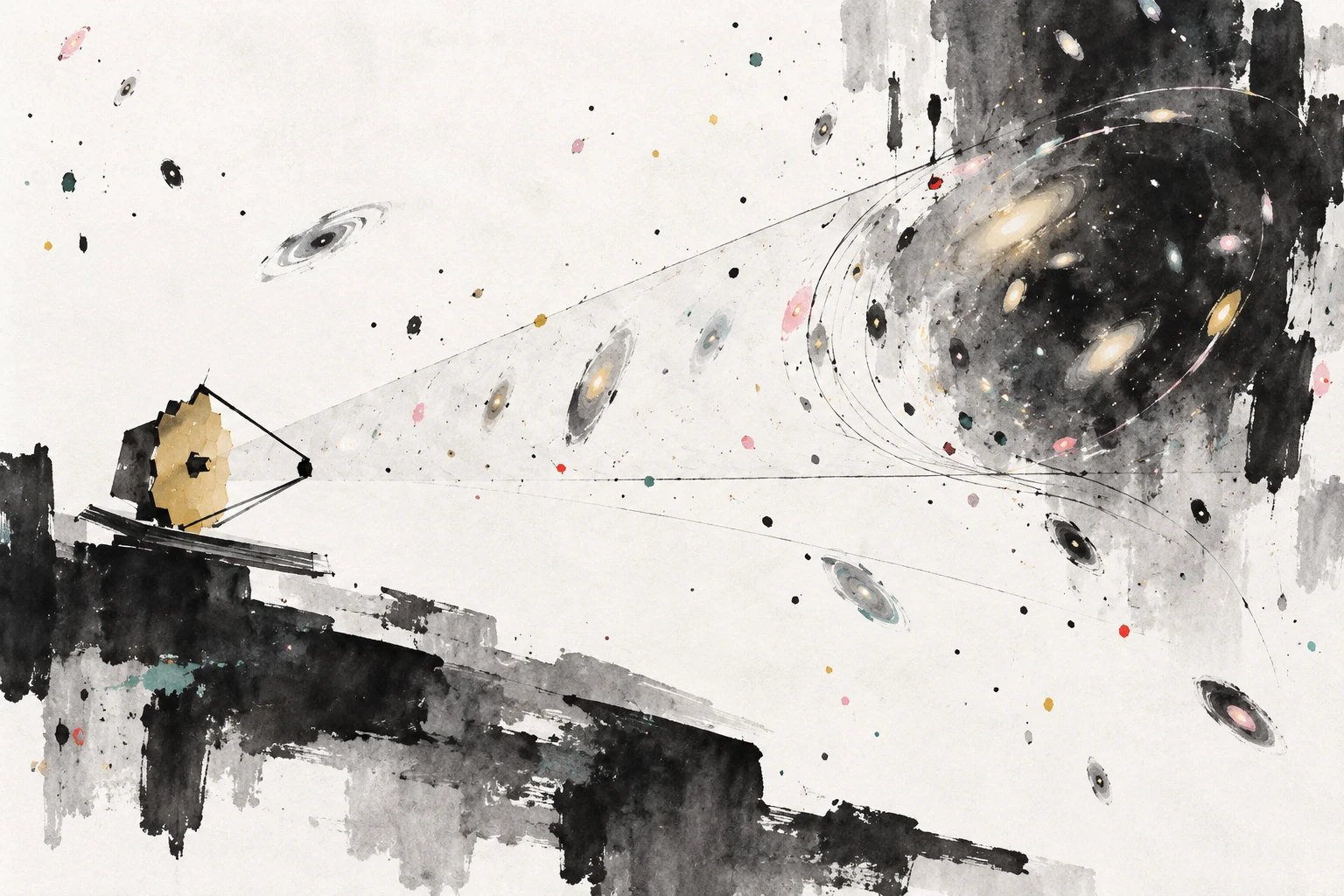
In a small patch of sky behind the galaxy cluster Abell 2744, the James Webb Space Telescope has used a natural magnifying glass to count some of the faintest star-forming galaxies of the distant universe.
The cluster's gravity warps space, bending and brightening light from galaxies far behind it. That lensing effect boosted JWST's NIRISS instrument as it gathered grism spectra—low-resolution rainbows of many galaxies at once—during the GLASS-JWST Early Release Science program. In a preprint posted to arXiv on Dec. 29, 2025, a team whose first two authors, Yuxuan Pang and Xin Wang, are at the University of Chinese Academy of Sciences reports a new census of galaxies glowing in Hα at redshifts around 1.3 and 2.0.
A gravitational telescope behind Abell 2744
Hα emission comes from hydrogen gas ionized by young, short-lived massive stars. It is a standard tracer of star formation, and because it is less affected by dust than ultraviolet light, it helps reveal galaxies that might otherwise be hidden. The luminosity function is a count of how many galaxies exist at each Hα brightness. Its faint-end slope, often written α, describes how quickly the number of galaxies rises as they get dimmer.
Cosmic noon, roughly the era between redshifts 1 and 3, is when the universe was forming stars most rapidly. The peak is often placed near z~2, billions of years after the Big Bang. Getting the faint end right is crucial: if many dim galaxies are missing, the total star-formation budget will be underestimated.
JWST observed the core of Abell 2744 with NIRISS in wide-field slitless spectroscopy for about 18.1 hours, plus direct imaging in three near-infrared filters. The grism spreads each source's light into a spectrum, letting astronomers identify emission lines. The cluster's lens model, built from 149 multiple images, indicated median magnifications of about 2.5 at z1.3 and 2.2 at z2.0. From 219 initial candidates, the team selected 99 Hα emitters. For the luminosity-function analysis, they focused on two redshift bins where Hα falls near the center of the F150W and F200W filters: z=1.05–1.5 and z=1.8–2.2. After treating two images of the same triply lensed galaxy as one source, the final sample contained 53 individual galaxies at z1.3 and 29 at z2.0.
Ten times fainter, with a steep faint end
Thanks to NIRISS sensitivity and lensing, the survey reached intrinsic Hα luminosities about ten times fainter than previous grism surveys. The detection limits were L_Hα ~ 10^40.5 erg/s at z~1.3 and 10^40.9 erg/s at z2.0, with completeness above 0.8. Those limits correspond to star formation rates of roughly 0.4 and 1.0 solar masses per year.
The team measured the faint-end slope to be -1.50 (+0.14/-0.08) at z1.3 and -1.60 (+0.17/-0.09) at z2.0, after including about 20% cosmic variance. Both values agree with earlier estimates from Hα surveys, and they imply at most weak evolution in the slope from cosmic noon toward the epoch of reionization. The result comes from extending the count about two orders of magnitude fainter than the characteristic luminosity L*, the break in the luminosity function.
One caveat: because NIRISS's spectral resolution is modest, Hα is blended with nearby [N II] lines. The measurements are therefore of the blended Hα+[N II] emission, following previous grism surveys.
A star-formation budget near cosmic noon
Integrating the fitted luminosity function, the authors estimate cosmic star-formation rate densities of 0.097 (+0.015/-0.016) solar masses per year per cubic megaparsec at z1.3 and 0.129 (+0.025/-0.030) at z2.0. The increase from z1.3 to z2.0 is consistent with the broad picture that cosmic star formation peaked around z~2. The values also agree with previous dust-corrected ultraviolet and Hα estimates, though they are slightly higher than some infrared and radio measurements.
The team checked for active galactic nuclei, which can also produce bright Hα, and found no broad-line AGN among the emitters. A cross-match with known AGN catalogs found none, and an estimate from the quasar X-ray luminosity function predicted only about 0.3 AGN in the survey volume. The authors conclude that bright AGN contamination is negligible. They also argue that Type 2 AGN are unlikely to contribute significantly, though NIRISS cannot resolve the [N II] lines used in some standard diagnostics.
The characteristic luminosity L* is poorly constrained because the survey volume is limited and there are few bright sources. That creates a strong degeneracy between L* and the faint-end slope, so the team used priors from previous studies when fitting. Cosmic variance—the fact that one patch of sky may not represent the universe—is estimated at about 20%. The star-formation rate conversion assumes a dust correction of A_Hα = 1.0 mag, which is simplified and may vary with galaxy mass and star formation. Variations in the assumed stellar initial mass function could also introduce additional systematic bias. And this is a preprint, not yet a peer-reviewed journal article.
Even with those caveats, the work shows how JWST can combine slitless spectroscopy with gravitational lensing to build deep, spectroscopically confirmed samples of faint star-forming galaxies. The authors say their per-source method for estimating volume and completeness can be applied to other JWST NIRISS programs and to future wide-field slitless surveys, including Euclid, Roman, and the Chinese Space Station Telescope.
For now, the view behind Abell 2744 offers a sharper look at the faint end of the galaxy population during the universe's most productive era. The bright beacons are important, but the dim red glows help trace the star-formation budget.