A Neural Network Simulates LIGO-Like Optics 815 Times Faster—A Possible Design Shortcut
A graph neural network trained on high-fidelity optical simulations reproduces power and intensity patterns for LIGO-like interferometer models hundreds of times faster than standard tools, offering a possible shortcut for future detector design.
Dec 18, 2025
The Expensive Art of Listening for Spacetime
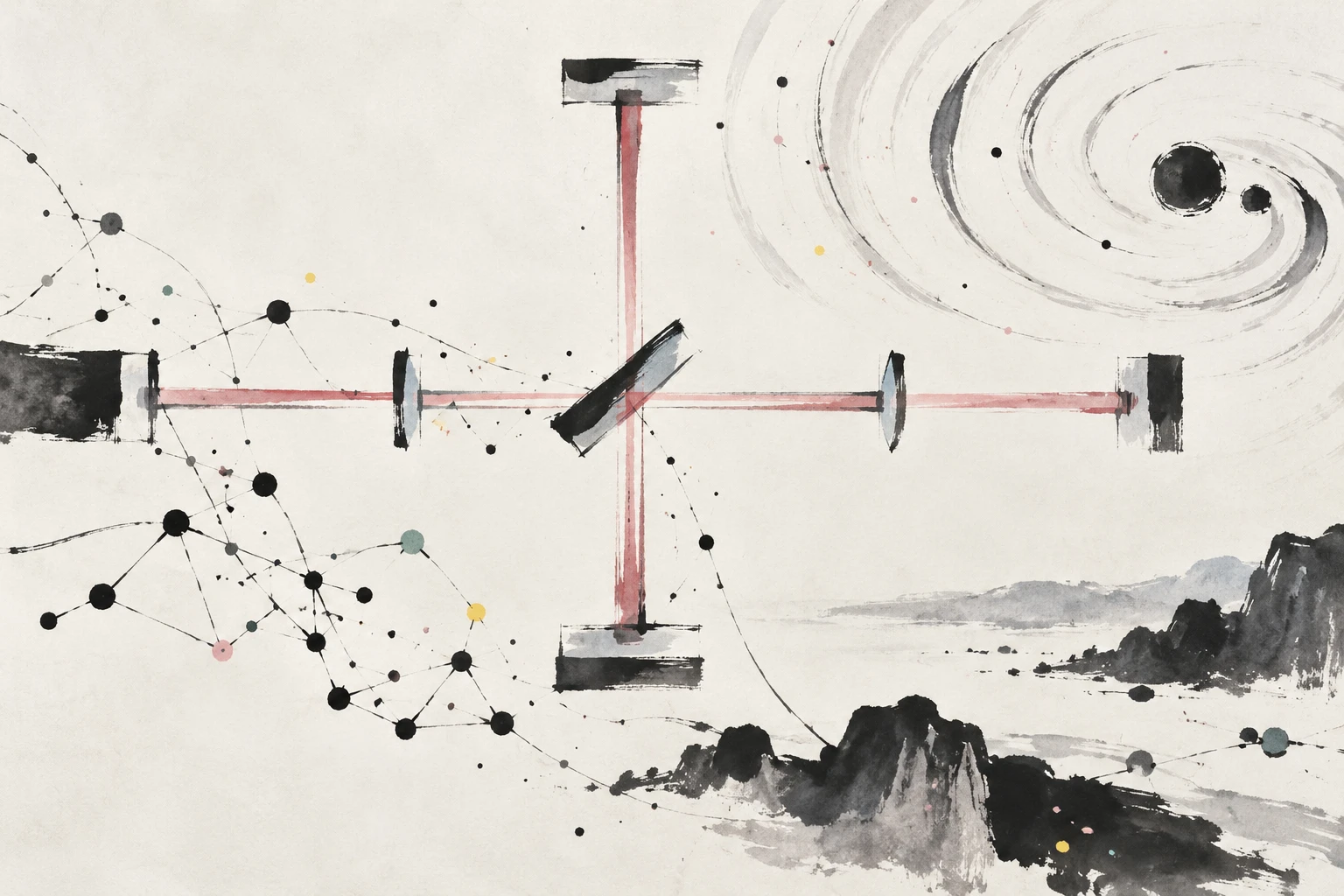
Inside LIGO, laser light is not a simple beam. It circulates in the arm cavities, reflecting hundreds of times between mirrors, building up kilowatts of power, and then cancelling almost perfectly at the readout port. A passing gravitational wave—a ripple in spacetime—disturbs that delicate balance by stretching or contracting the arm lengths. Designing such an instrument demands optics that are exquisitely sensitive and robust to manufacturing flaws.
That design work has a practical bottleneck: simulation. Each candidate combination of mirror curvature, reflectivity, and spacing must be tested by solving how the light field propagates and interacts. For future detectors such as Cosmic Explorer, optimizing those parameters could require thousands of costly high-fidelity simulations. A new study, posted on arXiv in December 2025 and prepared for the AI for Science workshop at NeurIPS 2025, asks whether a machine-learning model can serve as a faster stand-in.
An Interferometer as a Graph
The authors turn to graph neural networks. A GNN is a machine-learning model built for data organized as nodes and edges. It learns by passing messages between connected nodes. That structure fits an interferometer well: light fields and optical components are not independent; they are linked in a specific network of reflections, transmissions, and cavities.
The team represents each mirror as four nodes, separating incoming and outgoing fields. Edges represent the paths between fields and optics. The network then learns to predict two things: the power entering and leaving each point in the interferometer, and the spatial intensity distribution at each point. The ground truth comes from FINESSE, a standard interferometer simulation package. This is important: the work is trained and tested on simulations, not on new measurements from LIGO itself.
They created datasets for three increasingly complex optical layouts: a simple Fabry-Perot cavity, a coupled cavity, and an Arm-SRC coupled cavity—a LIGO-like arm cavity linked to a signal-recycling cavity, which helps amplify signal light. To generate data, the authors started from ideal, perfectly mode-matched configurations and randomly perturbed mirror curvatures, reflectivities, and spacings. They collected 30,000 graphs for the Fabry-Perot and Arm-SRC cases and 5,000 for the simpler coupled cavity. The model is trained on locked interferometer data; it does not perform the locking procedure itself.
What the Network Learned to Predict
For power prediction, the GNN with graph attention layers outperformed models that ignored graph structure, such as plain multilayer perceptrons or Kolmogorov-Arnold networks. The graph model also generalized better to an unseen topology, though not perfectly. A model trained only on the simplest Fabry-Perot cavity struggled with the more complex Arm-SRC setup. Adding a relatively small number of Arm-SRC examples to the training mix improved performance substantially, the authors report.
The second model predicted the 2D intensity distribution on optics. It used the radial symmetry of the beam to learn a radial profile, then rotated it to form the full pattern. This reduced the problem's complexity and enforced a physical expectation: in these cases, the beam is symmetric around its axis. This model achieved an L1 loss of 27.2 W/m², compared with 58.4 W/m² for an otherwise similar model using a standard multilayer perceptron instead of the KAN component. In examples, it captured both the large power difference between the laser field and the cavity field and the higher-order spatial modes visible in reflected light—patterns that matter for keeping power in the desired beam shape.
Hundreds of Times Faster, With Boundaries
The headline number is speed. For a single simulation of an Arm-SRC-like topology, the paper reports FINESSE taking 2.857 seconds and another standard package, SIS, taking 14.932 seconds. The GNN's power prediction ran in 0.018 seconds; its intensity prediction ran in 0.011 seconds. The abstract summarizes the result as runtimes 815 times faster than state-of-the-art simulation packages. In a short optimization test for a Fabry-Perot cavity, both FINESSE and the GNN found the same optimal solution, about 10 watts of circulating power, but FINESSE took 170.8 seconds and the GNN took 53.7 seconds. The authors note that overhead from converting the interferometer model into a graph format limited the speedup there.
Those gains come with boundaries. The model does not simulate a full LIGO interferometer. It handles a relatively small portion of the relevant physics, and the authors describe it as a proof of concept. It does not perform locking, and its generalization to unfamiliar optical topologies is not as good as its performance on layouts seen during training. Future work would need to include effects such as thermal lensing, point absorbers on mirror surfaces, and astigmatic beam shapes—effects the paper says would need to be included for full-scale interferometer design. The paper also notes a broader challenge for machine-learning surrogates: generating training data is itself computationally expensive.
A Sketchpad, Not a Replacement
Still, the authors argue that a surrogate does not need to be perfect to be useful. In optimization, even a rough model can flag designs that are unlikely to work, allowing a slower, high-fidelity simulation to focus on the most promising candidates. That is the core promise: not replacing optical simulations, but using a learned sketch to explore a vast design space more quickly.
If that promise extends to more complete physics, it could help shape the next generation of gravitational-wave observatories—machines that listen for black hole and neutron star mergers by measuring the faintest stretching of spacetime. The light inside them may be complex, but the problem of designing their mirrors may become a little less computationally dark.