Can Light Slip Through a Wall? ALPS II Sees No Axion Signal—but Sharpens the Search
In its first science campaign, the ALPS II experiment at DESY found no evidence of axions or similar light particles, setting an axion-like-particle limit more than twenty times tighter than previous light-shining-through-a-wall searches.
Dec 16, 2025
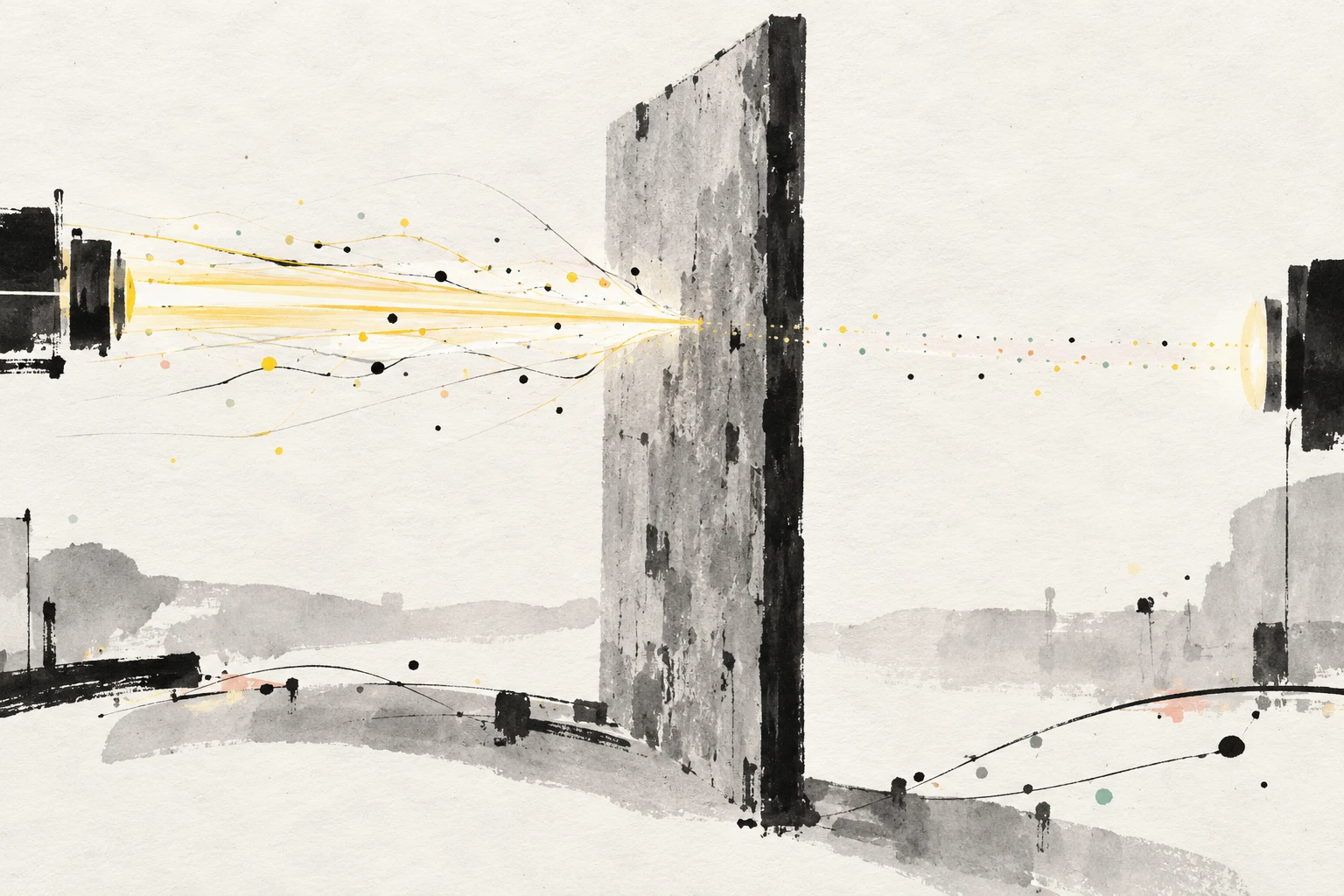
At DESY in Hamburg, a tunnel once used to steer protons around the HERA accelerator now hosts a wall that laser light should never cross. On one side, a powerful infrared laser fires into a string of superconducting magnets. On the other side, a sensitive detector waits in darkness. If a hypothetical particle called an axion exists, the laser's photons could occasionally turn into one, pass through the wall as if it were not there, and turn back into light.
That is the idea behind ALPS II, the Any Light Particle Search II. In its first science campaign, run from February to May 2024, the experiment saw no evidence of axions or similar weakly interacting slim particles, often called WISPs. The collaboration reported the results in an arXiv preprint. The result is not a discovery. It is a sharper limit—and a demonstration that a difficult machine works.
Why hunt for a particle that may not exist?
Axions and related particles are motivated by more than curiosity. The axion was originally proposed to explain why the strong nuclear force seems to conserve a certain symmetry, CP, far better than expected. Later work showed that axion-like particles could be extremely light, interact very feebly with ordinary matter, and perhaps make up part of dark matter. Hidden photons and other WISPs appear in many theories beyond the Standard Model.
Because these particles would interact so weakly, they cannot be found at ordinary particle colliders. Dedicated experiments are needed. ALPS II belongs to a category called light-shining-through-a-wall. It neither assumes that axions fill the dark matter halo nor that the Sun produces them. It tries to create and detect them in the laboratory.
Old magnets, new precision
ALPS II uses 24 superconducting dipole magnets from HERA, the particle accelerator shut down in 2007. Twelve magnets sit before the wall, twelve after it. Each provides a magnetic field of about 5.3 tesla. The two 12-magnet strings sit in a roughly 300-meter straight section; each string has about 106 meters of magnetic length. The magnets had to be straightened in place without removing their cold mass from the cryostat, a brute-force procedure that preserved their performance decades after construction.
In the first campaign, the team used a 1064.5-nanometer laser with about 25 watts of injected power. Behind the wall, a regeneration cavity stored light for many round trips, enhancing the chance that any particle converting back into a photon would be detected. The team sensed the light using a heterodyne technique, comparing a local oscillator laser with the light leaving the cavity. To calibrate the system, they briefly opened a shutter in the wall and let a tiny amount of laser light through.
The campaign collected about 580,000 seconds of valid data with light polarized perpendicular to the magnetic field and about 1,060,000 seconds with light polarized parallel to it. The machine maintained laser frequency control at the sub-microhertz level and sensed signals below 10^-22 watts.
A broad bump, but not the expected signal
If new bosons were being produced and regenerated, they would appear as a narrow signal at a specific beat frequency on the detector. In the raw spectrum, the team did see a broad bump near that frequency. But it was much wider than a light-shining-through-a-wall signal should be. The collaboration says it is likely caused by stray light passing around the wall, not by new particles. Using nearby frequencies to estimate the background, the signal bin was consistent with no significant excess.
For pseudoscalar bosons such as axions with masses below about 0.1 meV, or milli-electron volts, a tiny unit of energy often used for particle masses, ALPS II set a 95% confidence upper limit on the coupling between the particle and two photons: |g| < 1.5 × 10^-9 GeV^-1. That is more than a factor of 20 better than any previous similar experiment. The team also reported limits for scalar bosons, vector bosons often called hidden photons, and tensor bosons. The vector limit on the kinetic mixing parameter is |epsilon| < 2.0 × 10^-7. The combined tensor limit is G'/G < 5.8 × 10^18, where G' is the tensor-boson coupling and G is the standard-graviton coupling.
A null result does not mean axions are ruled out. It means that within a certain range of masses and couplings, these particles did not show up in this experiment. The limits assume specific ways the particles interact with photons. The broad stray-light feature also meant the background at the signal frequency had to be estimated from nearby frequencies. The vector boson search improved less dramatically than the axion search because hidden photons do not need magnetic fields to mix with ordinary photons, so ALPS II's unique magnets give less advantage there.
Still, the first campaign achieved something important: stable operation and robust calibration of a complex optical experiment. The collaboration is now upgrading the optical system. The plan includes reducing stray light, adding the production cavity before the wall, and later improving the regeneration cavity's finesse, a measure of how well it stores light. The goal is another two orders of magnitude in sensitivity, enough to rival some astrophysical axion searches.
For now, the wall remains dark to ordinary light. The absence of a narrow signal at the expected frequency is not empty. It is a measurement, and it pushes the boundary of where a hidden particle might still be hiding. The planned upgrade aims to make that boundary tighter—or, if nature is kind, finally let a little light through.