
Could a Primordial Black Hole Explain JWST’s Overmassive Oddball?
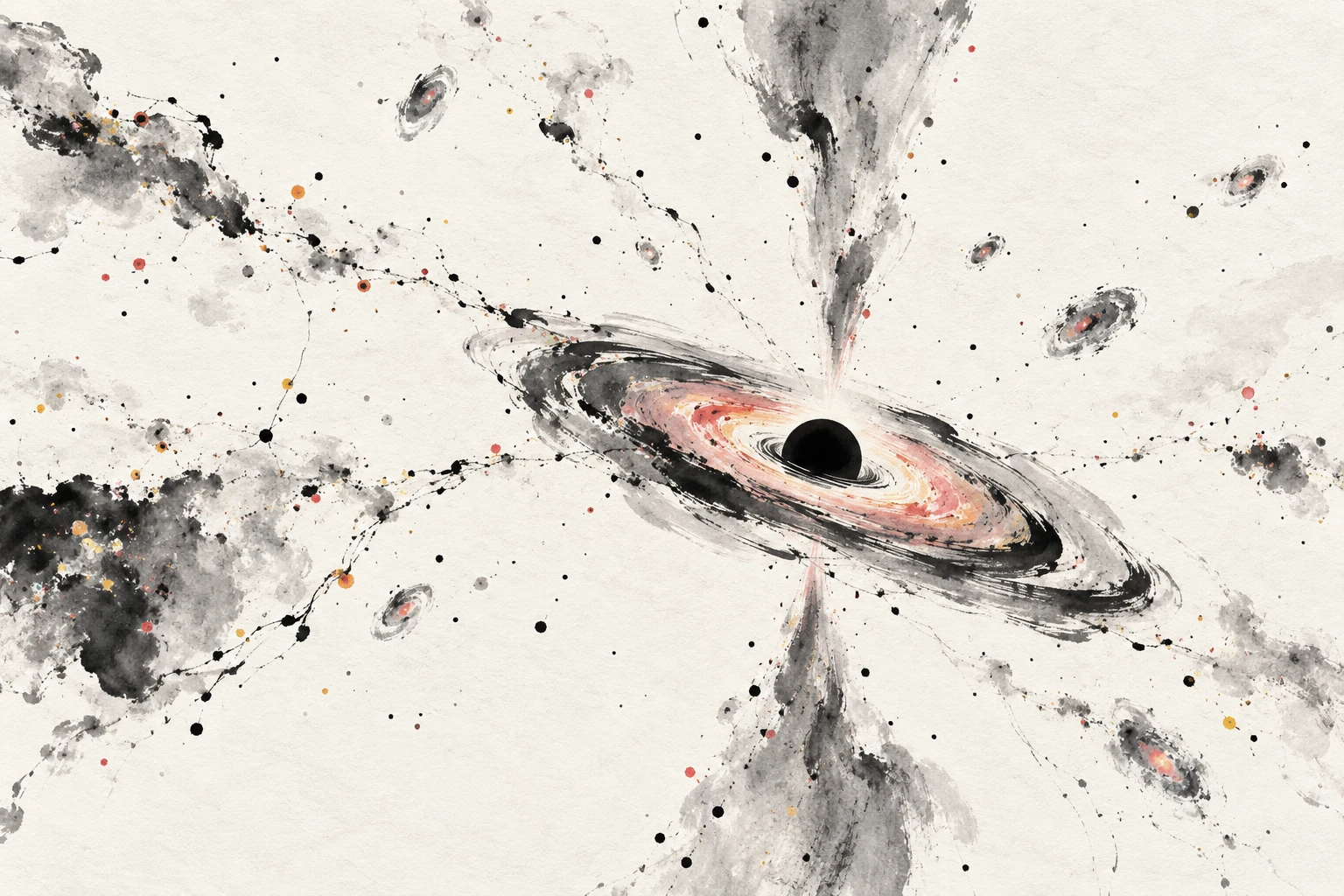
New cosmological simulations suggest that a 50-million-solar-mass primordial black hole could naturally yield Abell 2744–QSO1’s extreme black-hole-to-stellar mass ratio and metal-poor gas.
Dec 16, 2025
At first glance, Abell 2744–QSO1 looks less like a galaxy than a black hole with a few stars caught around it. JWST observed the object at a redshift of about 7, roughly 700 million years after the Big Bang, and astronomers inferred a black hole of about 50 million solar masses. Its stellar mass is far smaller—perhaps under a million solar masses in some analyses—and its gas is extremely metal-poor, with only about one percent or less of the Sun’s heavy-element abundance.
The puzzle is not just that the black hole is big. It is that the galaxy around it seems too small and too pristine to have grown the black hole by ordinary means.
Why Standard Seeds Stumble
Traditional models often start with light seeds: black holes left behind by the first, massive Population III stars—the first generation of stars, made only of hydrogen and helium. To reach 50 million solar masses by redshift 7, those seeds would need to accrete gas at super-Eddington rates—above the Eddington limit, the rough maximum at which radiation pressure can balance gravity—for long stretches of cosmic time. Another route, the direct collapse of pristine gas, requires intense Lyman–Werner ultraviolet radiation to suppress cooling and fragmentation; Lyman–Werner light can break up molecular hydrogen, the main coolant in primordial gas. Astronomers have not found such a source near Abell 2744–QSO1.
Primordial black holes offer a third option. These are hypothetical black holes formed from density fluctuations shortly after the Big Bang, before galaxy formation. If a massive one—about 50 million solar masses—was already in place, it could act as a gravitational seed, pulling in dark matter and gas and accelerating the growth of structure.
The new work, by Saiyang Zhang, Boyuan Liu, Volker Bromm, and Florian Kühnel, is a set of high-resolution cosmological simulations posted as a preprint on arXiv, not a new observation. The team used the GIZMO code to simulate a region with side length 1 h⁻¹ Mpc (about 1.5 megaparsecs for the adopted cosmology). A dark-matter-only precursor followed the central primordial black hole from redshift 3400 to recombination at redshift about 1100; the full gas-and-star runs then evolved from redshift about 1100 to redshift 7. At the center they placed a single primordial black hole of 50 million solar masses. Crucially, they coupled three ingredients that earlier studies often treated separately: gas accretion onto the black hole, thermal feedback from that accretion, and the formation and feedback of Population III and Population II stars. One run included full stellar feedback; another left stellar particles passive for comparison.
The Feedback That Delays Star Formation
Across both runs, the black hole accretes at roughly 1 to 10 percent of the Eddington rate—a standard measure of the maximum flow a black hole can sustain before radiation pressure pushes gas away. That modest pace matches the 1 to 3 percent inferred for Abell 2744–QSO1. By redshift 7, the simulated black hole has grown to about 60 million solar masses.
Yet the black hole’s feedback is powerful. It heats surrounding gas and delays star formation until redshift less than about 10. When stars finally form, they do so in short bursts. In the run without stellar feedback, a first burst lasts about 50 million years, followed by a roughly 50-million-year quiescent period; by redshift 7, about 20 million solar masses of stars have formed. In the run with full stellar feedback, only one roughly 50-million-year episode occurs before the system quenches, leaving about 770,000 solar masses of stars, split between Population III and Population II. That tiny stellar mass is consistent with the tightest observational limits for QSO1.
Metals In, Metals Out
The simulations also offer a mechanism for the object’s low metallicity. Supernovae from the first stars enrich nearby gas. But accretion-driven outflows from the black hole push that enriched material out of the nucleus, while fresh, pristine gas flows in from the intergalactic medium. The result is a feedback-regulated cycle: star formation and metal enrichment proceed in bursts, then are suppressed and diluted. In the central 150 parsecs, the simulation can reach about a tenth of solar metallicity by redshift 7.8, while the outer 150–300 parsec region reaches about one percent of solar. After strong outflows, the average in the black hole’s vicinity drops to levels consistent with JWST’s measurements.
Together, low accretion, bursty star formation, and diluted metals naturally produce an extreme black-hole-to-stellar mass ratio. The team suggests Abell 2744–QSO1 may be caught either during or just before its first starburst at redshift greater than about 9 or in a brief post-quenching phase near redshift 7. It may be a sub-class of the broader population of JWST-discovered ‘little red dots’—compact, extremely red sources.
What JWST May Be Catching
The broader picture is that heavy seeds could bypass some of the hardest problems in early black hole growth. A primordial black hole does not have to be built from a star, and it does not need to wait for a galaxy to assemble around it. Instead, it arrives first and helps shape the galaxy that follows. In that scenario, the most extreme overmassive systems can arise naturally from a seed that was already massive when the universe was young.
Where the Picture Could Break
The result is a simulation-based explanation, not proof. The model places one idealized primordial black hole in an isolated box. It ignores an extended primordial black hole mass function, clustering, and mergers with forming galaxies—effects that could change gas inflow and growth. The simulated dark matter halo also develops a steep inner cusp; matching the observed rotation curve within one standard deviation would require lowering the central dark matter density within about 150 parsecs by a factor of two to five. Supernova feedback is handled in a subgrid way, with metals mixed uniformly in bubbles, which may underestimate local metallicity variations. And black hole feedback is purely thermal, leaving out radiation pressure, winds, jets, and radiative transfer that would be needed to predict detailed spectra.
Still, the work points to a striking possibility. Some of JWST’s most extreme overmassive red sources may not be ordinary galaxies struggling to explain an oversized black hole. They may be black holes that arrived first, from the primordial universe, surrounded by only a sparse, metal-poor stellar component. Future simulations with more realistic environments and mock spectra will test whether that story holds—but these simulations suggest massive primordial black holes offer a viable pathway for the most extreme early systems.