
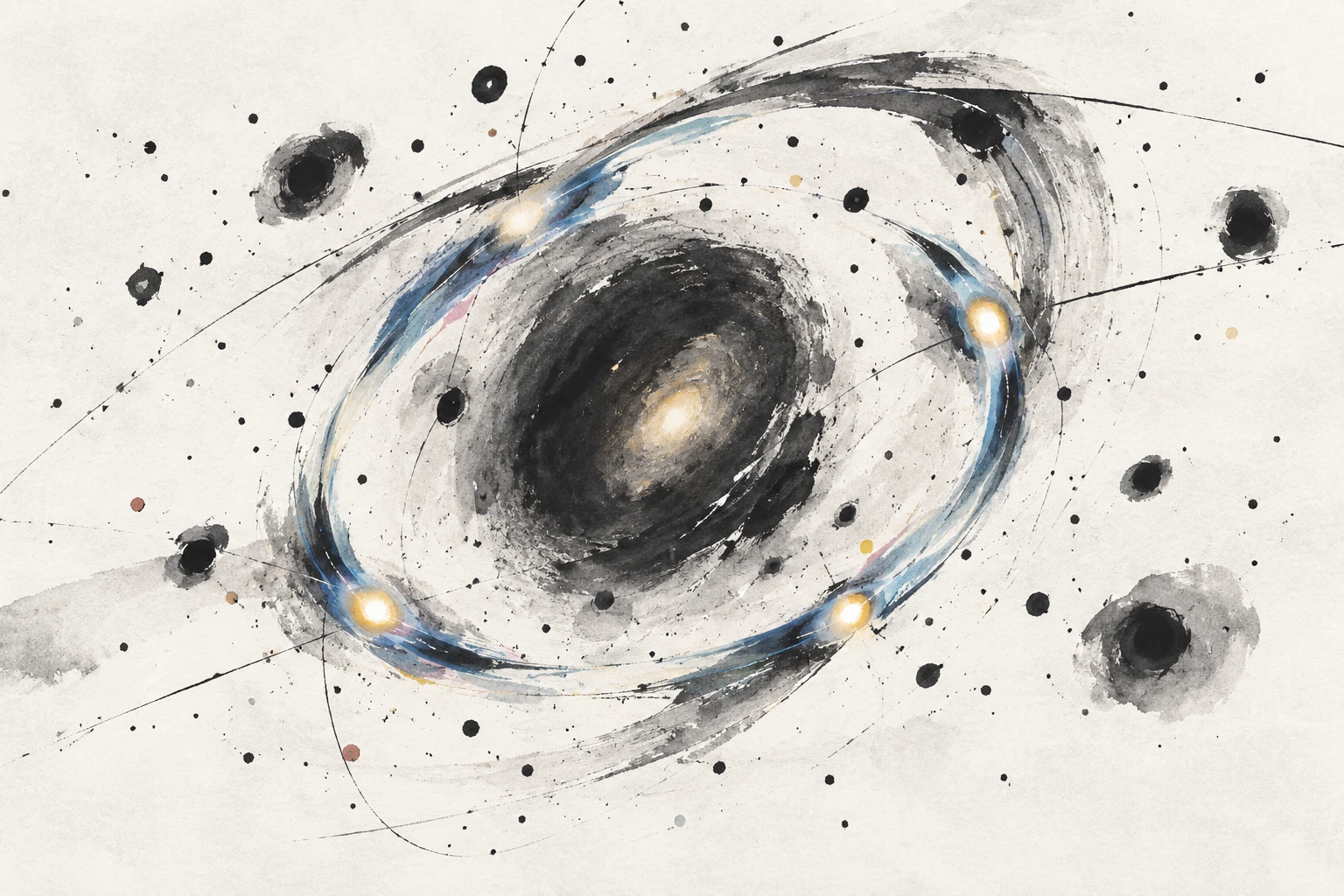
JWST’s Lensed Quasars Push Warm Dark Matter to a Tighter Limit—and Reveal a Subhalo Puzzle
Using 28 quadruply imaged quasars, astronomers set the strongest limits yet on warm dark matter and infer a higher projected mass density in small dark-matter clumps than some simulations predict.
Nov 10, 2025
A single quasar can appear four times in a telescope image. The trick is gravity: a massive foreground galaxy bends the quasar’s light, splitting it into a cross or diamond of images. Those images are not perfect copies. Their relative brightness—the flux ratios—can be subtly altered by invisible lumps of dark matter near the line of sight.
That is why astronomers have spent years turning quadruply imaged quasars into dark matter detectors. Now, a team using NASA’s James Webb Space Telescope has analyzed 28 such systems. For 26 of the 28, the team used JWST mid-infrared flux ratios from warm dust around the background quasar; two systems relied on narrow-line measurements. For 24 systems, the team also modeled extended lensed arcs from Hubble and JWST imaging. Their new preprint, posted to arXiv, reports the strongest constraints yet on warm dark matter and the most precise measurement of subhalo abundance around strong lenses. The results also reveal a mild tension with recent N-body computer simulations.
A Cosmic Scale Made of Gravity
Strong gravitational lensing turns a foreground galaxy into a magnifying glass. If the background source is a quasar, its light can be bent into four separate images. The pattern depends on the mass distribution of the foreground galaxy—including its dark matter halo and the smaller clumps, or subhalos, orbiting within it. Even a tiny clump can change the brightness of an image if it lies close to the light path.
But there is a catch. The main galaxy’s mass profile is not perfectly known. Two different combinations of galaxy shape and dark matter clumps can produce nearly identical image positions and flux ratios, making it hard to tell whether a brightness anomaly comes from a dark matter subhalo or from an uncertain galaxy model. This degeneracy has limited previous dark matter inferences.
The new work breaks that degeneracy by adding a third piece of information: extended lensed arcs. These arcs are the stretched images of the quasar’s host galaxy. By reconstructing the arcs together with the image positions and flux ratios, the team pins down the foreground galaxy’s mass profile more tightly. That, in turn, makes the predicted flux ratios more precise and isolates the effects of dark matter substructure.
Warm Dark Matter’s Shrinking Window
The target is the nature of dark matter. In the standard cold dark matter model, dark matter particles move slowly, allowing even tiny halos to form. In warm dark matter models, particles would have streamed freely in the early universe, smoothing out small-scale structure. The size of that suppression is described by the free-streaming length, often parameterized by the half-mode mass: the halo mass below which the number of halos drops significantly.
The team generated between 0.3 and 21 million simulated lens systems per lens, including subhalos, line-of-sight halos, globular clusters, and the tidal stripping that erodes subhalos over time. They then compared those simulations with the JWST and Hubble data.
When they assumed a subhalo abundance predicted by the semi-analytic model galacticus, they found a 10:1 Bayes factor limit of half-mode mass below about 10^7.4 solar masses. Using a prior from recent N-body simulations gave a slightly tighter bound, below 10^7.2 solar masses. Those limits correspond to lower bounds on the mass of a thermal relic warm dark matter particle—a simple particle candidate whose early-universe free streaming suppresses small structure—of 7.4 and 8.4 keV, respectively. The paper reports improvements of 0.4 dex and 0.3 dex, respectively—roughly a factor of two to three—over omitting the lensed arcs.
The authors call these the strongest limits on warm dark matter to date. In practical terms, the allowed window for a simple warm dark matter particle is narrowing.
A Subhalo Surplus—and What It Doesn’t Settle
The same data can be read the other way. If dark matter is cold, the measurements reveal how much mass is tied up in small subhalos near the lens. The team inferred a projected subhalo mass density—the mass in small clumps along the line of sight per square kiloparsec—of about 1.6 × 10^7 solar masses per square kiloparsec, with large uncertainties: from 0.5 to 4.0 × 10^7 at 95% confidence. That is consistent with the galacticus prediction of 0.6 × 10^7, but about five times higher than the 0.3 × 10^7 predicted by recent N-body simulations—a mild tension, roughly 2 sigma.
The mismatch is not yet a crisis. It could mean that the simulations are still missing subhalos because of artificial disruption or limitations in how subhalos are identified. Or it could hint that dark matter halos are more concentrated than expected, or that the team’s assumed distribution of host halo masses is slightly off. The paper lays out these possibilities without claiming a resolution.
The result does not rule out warm dark matter entirely. It rules out a broad class of simple thermal relic models with particle masses below about 7–8 keV, under specific assumptions about subhalo abundance. If the team had used a broad log-uniform prior on that abundance instead of a theoretical prior, the warm dark matter bound would be weaker: a half-mode mass below about 10^8.5 solar masses. The improvement comes from combining the lensing data with theoretical priors on how many subhalos should exist.
The analysis also depends on modeling choices, including the mass profile of the foreground galaxies, the size of the quasar’s emitting region, and the tidal evolution of subhalos. The authors test their pipeline extensively, but they note that future work with more lenses and better imaging will reduce statistical uncertainties and make the inferences more robust.
That future is already on the horizon. Surveys such as Euclid, the Rubin Observatory, and the Roman Space Telescope are expected to discover thousands of new strong lenses. Each one adds another chance for a dark matter clump to leave its fingerprint on a quasar’s light.
For now, the message from these 28 cosmic lenses is double-edged: warm dark matter has less room to hide, and cold dark matter’s smallest structures may be more abundant than some simulations predict—or those simulations may be missing some subhalos.