Could the Moon Give Us Months of Warning Before Neutron Stars Collide?
A new preprint forecasts that lunar gravitational-wave observatories could give weeks-to-months warning of neutron-star mergers and, paired with LIGO, localize them to a few square arcseconds.
Oct 6, 2025
In 2017, two neutron stars collided, and the ripples in spacetime reached Earth. LIGO and Virgo caught only the final minutes of their inward spiral, while telescopes saw the aftermath. That single event, GW170817, showed that neutron-star mergers forge heavy elements, put limits on how matter behaves at extreme density, and provided an independent way to measure the universe's expansion.
But that success also exposed a timing problem. Gravitational-wave detectors on Earth hear a binary neutron star only when it is already close to merging. The alert goes out late, and the patch of sky is wide. By the time telescopes turn, the most fleeting signals may already be gone.
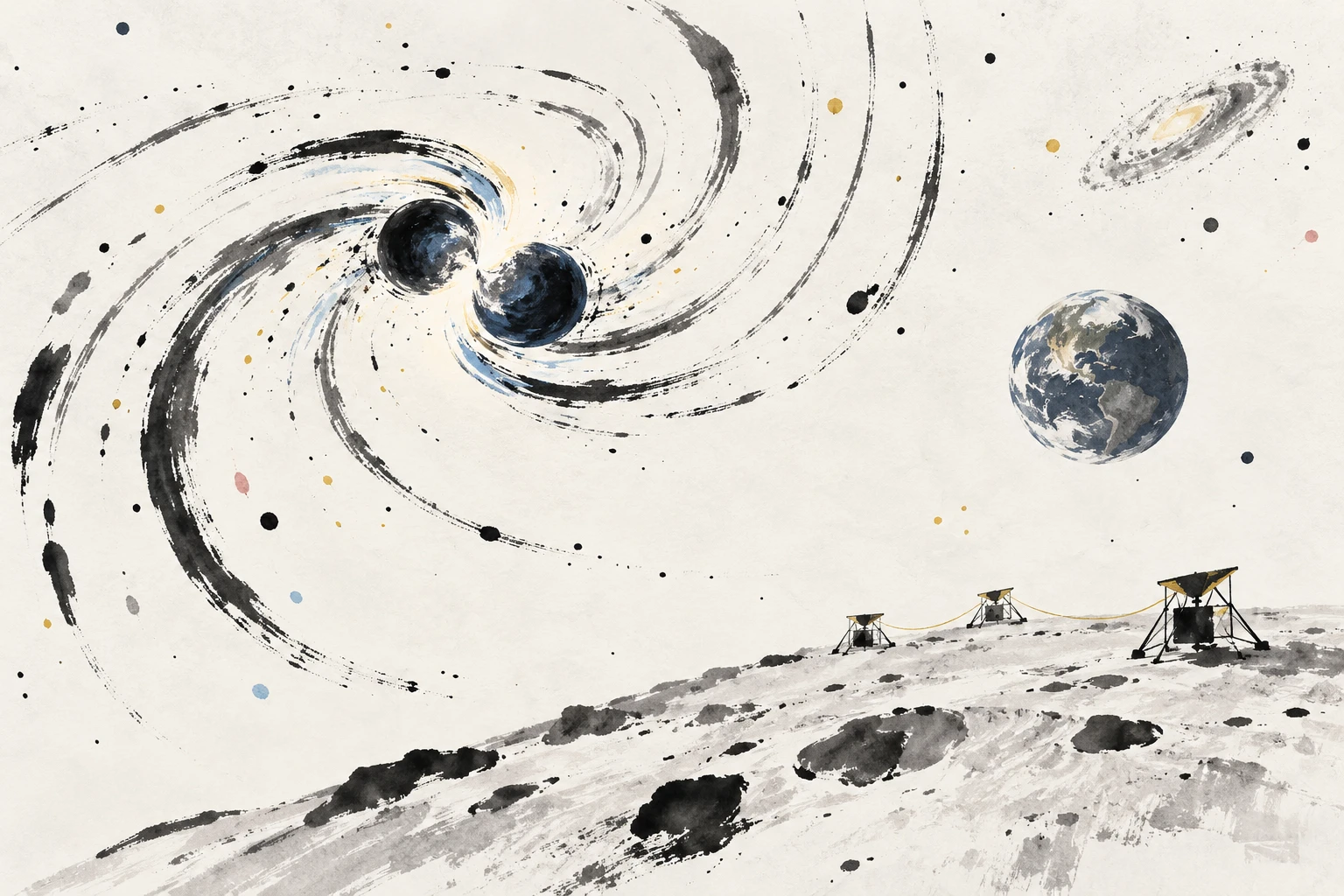
A new preprint asks whether putting gravitational-wave observatories on the Moon could change that. Anjali B. Yelikar and Karan Jani, at Vanderbilt University's Lunar Labs Initiative, analyze a GW170817-like source as it would appear to proposed lunar detectors and compare them with current and next-generation Earth-based facilities. The study is posted to arXiv and has not been peer-reviewed.
The problem with hearing only the final minutes
A binary neutron star emits gravitational waves as the two stars spiral together. The waves rise in frequency and strength as the end approaches. Current detectors such as LIGO, Virgo, and KAGRA are sensitive to roughly the last few minutes of that chirp. Third-generation Earth detectors like Cosmic Explorer and the Einstein Telescope would push into lower frequencies, but Earth's seismic noise still sets a floor.
The Moon has a different floor. It is seismically quieter and has weaker gravity, and the paper notes that natural lunar craters could host long detector arms without the underground excavation that Earth-based designs may need. The study considers two families of proposed lunar instruments. One uses seismometers to monitor the Moon's normal modes, represented by the Lunar Gravitational-wave Antenna, or LGWA. The other uses laser interferometers with suspended test masses, represented by the Gravitational-Wave Lunar Observatory for Cosmology, or GLOC. The Laser Interferometer Lunar Antenna, or LILA, is proposed as part of NASA's Artemis Lunar Exploration Program; the paper treats LILA-Pioneer with the seismic family and LILA-Horizon with the suspended family.
What the paper actually calculated
The authors did not observe a merger with lunar detectors. They computed how a simulated GW170817-like signal would appear in each detector's projected sensitivity. Using a software tool called GWFish, they estimated signal-to-noise ratios (how strong the signal is relative to detector noise), horizon distances (the farthest a source could be detected above a threshold, under optimal orientation and sky position), sky-localization areas, and measurement uncertainties.
For parameter uncertainties, they used a Fisher-matrix approach, a fast method that gives lower bounds on errors in the high-signal regime. That is a forecast, not a full Bayesian analysis. The paper notes that full lunar detector data analysis is still being developed.
Months of warning, and a pinpoint on the sky
The first payoff is time. For a GW170817-like source, the paper finds that the lunar seismic approach could in principle reach the detection threshold about three years before merger, though the authors set a practical one-year warning horizon for telescope follow-up. The lunar suspended-interferometer concept reaches the same threshold about 40 days before merger. By contrast, the Einstein Telescope reaches it around 15 hours ahead, the 40-km Cosmic Explorer concept about one hour ahead, and LIGO-Hanford only about five minutes ahead.
The second payoff is location. Lunar detectors can use those early, low-frequency waves to narrow the source's position while there is still time to plan. The paper reports that a lunar seismic detector could localize a GW170817-like source to less than 0.01 square degrees more than six months before merger. A lunar suspended detector could get to about 1.5 square degrees one day out. When lunar and LIGO observations are combined in a multi-band network, the localization can shrink to a few square arcseconds, an area the authors compare to the James Webb Space Telescope's field of view at high zoom.
That matters because many telescopes have fields of view smaller than a square degree. A precise, early sky map lets observatories watch the right patch before the collision, not after.
Hundreds of chances for multi-messenger astronomy
The paper also estimates how often such opportunities would arise. Using a simulated population of binary neutron stars, a Madau-Dickinson star-formation history, and a local merger rate of 320 Gpc^-3 yr^-1, the authors find that lunar detectors could see tens to hundreds of well-localized mergers each year. In one case, a lunar suspended detector could provide about 100 events per year localized to better than 10 square degrees with a day's warning. A lunar seismic detector would see about 20 well-localized events annually, limited by its distance reach.
Earth-only networks, even with proposed third-generation detectors, would not provide a one-day warning with good sky localization, according to the analysis. They would catch some events closer to merger, but with less time to coordinate. The lunar advantage is not just more detections; it is a different kind of campaign, where gravitational-wave, electromagnetic, and neutrino observatories can point together at the same event.
Precision that reaches into nuclear physics and cosmology
Precision is another payoff. In the multi-band forecasts, the paper reports mass-ratio uncertainties of about 0.1 percent, spin constraints to 0.001 percent, and luminosity distance errors around 1 percent for a GW170817-like source. Those numbers would help pin down the neutron star equation of state, the relation that describes how matter behaves at extreme densities.
Distance measurements matter for cosmology too. Binary neutron star mergers are standard sirens: their gravitational waves carry information about how far away they are. With better distances and sky positions, astronomers can make an independent measurement of the Hubble constant, the expansion rate of the universe. That is especially interesting because local and early-universe estimates of the Hubble constant currently disagree.
What this forecast does not yet prove
The results are projections. No lunar gravitational-wave observatory exists yet. The analysis assumes planned detector sensitivities, a GW170817-like source, and idealized measurement conditions. Fisher-matrix errors are lower bounds, so real uncertainties could be larger. Detection rates depend on assumptions about how often binary neutron stars merge and how they are distributed across cosmic history. And the paper is a preprint, meaning it has not yet passed peer review.
The Moon, however, offers something Earth cannot: a quiet, stable platform for the long-wavelength gravitational waves that arrive before the final frenzy. If instruments like LILA, LGWA, or GLOC are built, they could turn a fleeting collision into a planned observation, giving telescopes months to prepare and giving physicists a sharper view of matter at its most extreme. The next great multi-messenger event may not be caught at the last minute. It may be awaited.