
What Killed a Massive Galaxy 700 Million Years After the Big Bang?
Using FLARES simulations, astronomers found two analogues of the record-breaking quiescent galaxy RUBIES-UDS-QG-z7, suggesting its rapid shutdown may have been driven by AGN feedback while exposing a lingering mismatch in galaxy number counts.
Sep 19, 2025
At first glance, RUBIES-UDS-QG-z7 looks like a contradiction. JWST observed it as it was roughly 700 million years after the Big Bang, when the universe was young and galaxy formation should have been vigorous. Yet this galaxy had already assembled a huge stellar mass and then shut down star formation. Astronomers call such objects quiescent: their star formation rate is tiny relative to their mass. RUBIES-UDS-QG-z7, or RQG, is the earliest massive quiescent galaxy identified so far, at redshift 7.29, a measure of how far cosmic expansion has stretched its light.
A dead galaxy in the cosmic dawn
RQG was first identified from imaging in the UltraDeep Survey field and then followed up with JWST's NIRSpec spectrograph as part of the RUBIES programme. Its spectrum does not show strong emission lines, but strong Lyman and Balmer breaks constrain its redshift to 7.29. SED fitting, which infers physical properties by matching a galaxy's brightness across wavelengths, suggests a stellar mass of about 10^10.23 solar masses, or roughly 17 billion Suns, formed in an intense burst lasting less than 200 million years. Then star formation stopped abruptly.
That is awkward. In the standard picture, galaxies build up over time through hierarchical assembly, and the processes that quench star formation, such as gas depletion or feedback from stars and black holes, have more time to act at later cosmic epochs. Finding one so early challenges models to grow and kill a massive galaxy within about 600 million years of the Big Bang. It also raises a counting problem: the implied number density of such objects is far higher than some simulations predicted.
Hunting for a twin in FLARES
To see whether current theory can make an RQG-like galaxy, Jack Turner and colleagues searched the First Light And Reionisation Epoch Simulations, or FLARES. FLARES is a suite of hydrodynamical zoom simulations that re-simulate rare environments from a much larger dark-matter-only simulation. The team generated synthetic JWST photometry and spectra for simulated galaxies, then compared the shape of their spectral energy distributions with RQG's.
The search found two compelling analogues: FRA-1 and FRA-2. They were the best matches in 55 percent and 42 percent of matching iterations, respectively. Both are massive and quiescent, both have red colors and strong Balmer breaks, and both are dominated by a rapidly quenched burst of star formation. FRA-1 is the closest match, with a mass, metallicity, and recent star formation rate broadly consistent with some of the observational fits. FRA-2 is less massive and shows signs of a later uptick in star formation, but its history still resembles a burst that was cut short.
The black hole that pulled the plug
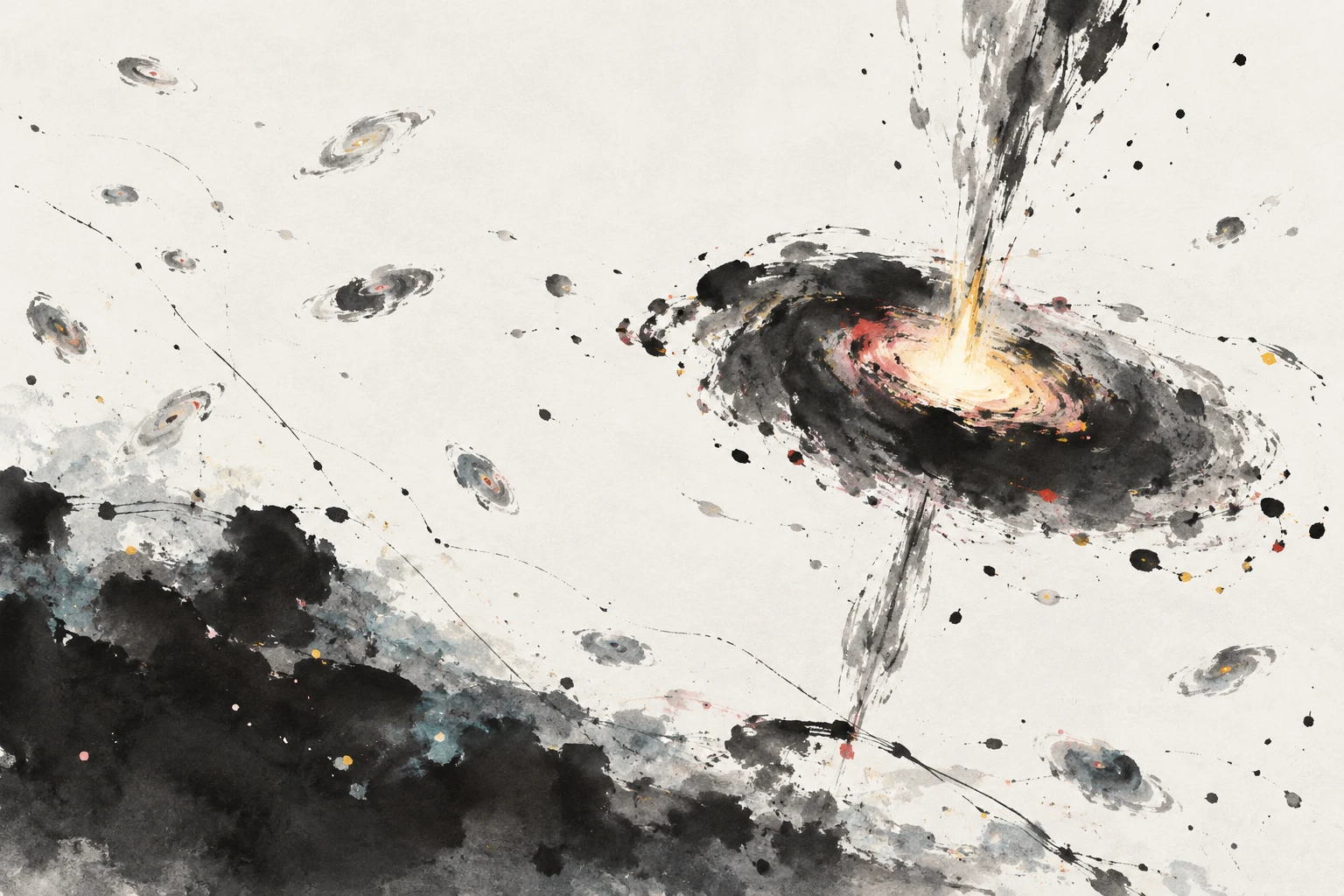
The simulations allow the authors to examine what quenched the simulated analogues. Stellar feedback, the winds and supernovae from massive stars, disrupts gas but cannot remove it efficiently enough to keep star formation off. The decisive actor appears to be the active galactic nucleus, or AGN: a supermassive black hole pulling in surrounding gas and releasing enormous energy.
In FRA-1, AGN feedback heats star-forming gas and then expels it. The galaxy's gas fraction drops from about 60 percent to less than 1 percent in roughly 150 million years. With so little cold gas left, star formation cannot restart in a timely way. The black hole has already grown massive enough to regulate future star formation. The paper argues that heating is especially important for making the galaxy appear quiescent, while expulsion ensures the shutdown lasts.
If this picture applies to RQG, its AGN may be difficult to see directly. With little gas left to accrete, the black hole can be faint except during brief episodes. The authors note that indirect evidence, such as a measured gas outflow, may be the best near-term way to confirm an AGN in RQG.
A metallicity measurement that may be off
There is another puzzle. FLARES predicts that RQG-like galaxies should be chemically enriched, with super-solar metallicity, meaning more elements heavier than helium than in the Sun. But one standard SED-fitting analysis of RQG inferred a much lower metallicity, around a tenth of solar. A second analysis with a different prior found super-solar values. Both fits were statistically comparable.
The authors tested whether alpha-enhancement, an elevated ratio of oxygen to iron, could explain the discrepancy. It cannot do so alone. When they applied the same fitting methods to their simulated analogues, the inferred metallicities were systematically too low. The likely culprits are degeneracies with age and dust attenuation: different combinations of age, dust, and metallicity can produce similar-looking spectra. Dust attenuation, in particular, appears to be overestimated in the gas-poor analogues. The team calls for submillimeter observations to better constrain dust and break the degeneracy.
The missing-galaxy problem remains
RQG also sits at the center of a number-density tension. The density implied by RQG for such massive quiescent galaxies at redshift 7 is at least 150 times higher than earlier FLARES predictions. The new work shows that some of the gap comes from choices about how quiescence is defined, over what timescale star formation is averaged, and what aperture is used to measure a galaxy's mass and star formation. Systematics can narrow the gap, but not erase it.
The authors suggest that the simulation's AGN feedback may need strengthening. One possibility is allowing super-Eddington accretion, in which a black hole swallows matter faster than the standard Eddington limit. That would boost feedback preferentially in massive galaxies and could quench more of them earlier, without necessarily destroying agreement with the overall galaxy mass function. But this remains a hypothesis, not a solved problem.
What the twins can and cannot settle
The study does not prove that RQG was quenched by an AGN. It rests on a single observed galaxy and two simulated analogues, and the comparison is limited by SED-fitting uncertainties. AGN emission is not included in the forward-modelled photometry, and the simulations rely on subgrid recipes for feedback. Cosmic variance, the chance that RQG sits in an unusual patch of sky, also affects the number-density comparison. The work is posted as a preprint and should be read with those caveats.
Still, the result changes the tone of the puzzle. Instead of treating RQG as an impossible object, the simulations show that galaxies with similar observable properties can form in the current model, even earlier than RQG. Their histories point to a familiar cosmic character: a growing black hole that heats and blows away the gas a galaxy needs to make stars. The earliest massive dead galaxies may be not freaks of nature but signposts of black-hole feedback operating at full force in the infant universe.