Did Early Quasars Drive Extreme Winds That Could Shut Down Their Galaxies?
JWST spectra of 27 luminous quasars at redshifts 5–6 reveal that six show extreme, fast [O III] outflows, a much higher rate than in lower-redshift comparison samples and a possible clue to early galaxy quenching.
Sep 10, 2025
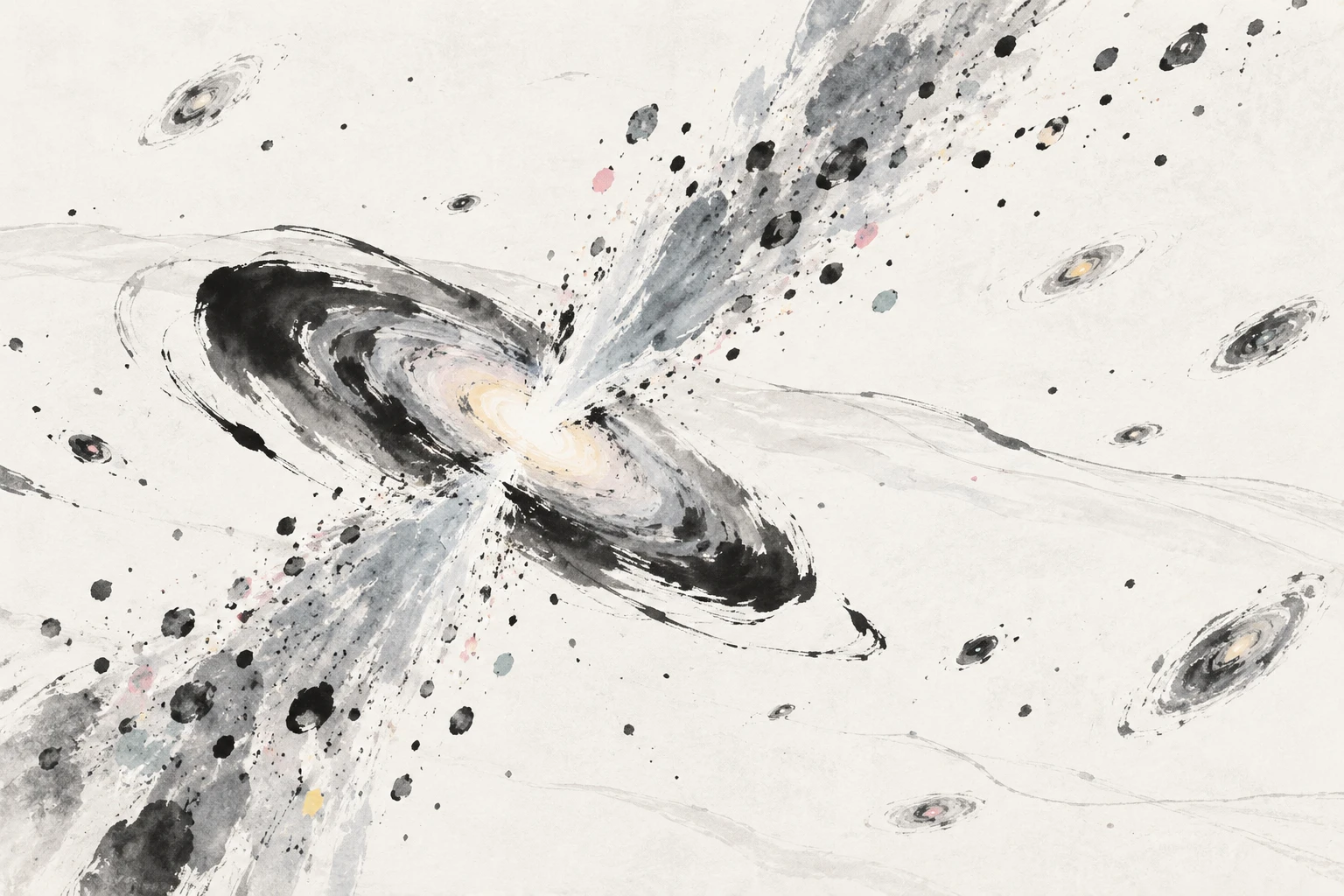
About a billion years after the Big Bang, a galaxy already hosted a supermassive black hole bright enough to be seen across the observable universe. That much is expected for a luminous quasar. What the new JWST observations reveal is what the surrounding gas was doing: streaming outward at thousands of kilometers per second.
A new study posted to arXiv reports that such extreme winds are not rare among the brightest quasars of the early universe. Using the James Webb Space Telescope, a team led by Weizhe Liu of Steward Observatory at the University of Arizona analyzed 27 luminous quasars at redshifts of about 5 to 6. The survey observed 28 targets; one was unusable because of detector persistence. Redshift measures how much cosmic expansion has stretched the light on its way to us; this range corresponds to roughly one billion years after the Big Bang. The work is a preprint and has not yet completed peer review.
An Oxygen Line That Betrays Escaping Gas
JWST's Near-Infrared Spectrograph, used in integral field unit mode, can split the light from a small patch of sky into spectra at many positions. That lets astronomers study the rest-frame optical light of early quasars, which expansion has shifted into the near-infrared.
The key tracer is a line from doubly ionized oxygen, called [O III] at a rest wavelength of 5007 angstroms. In luminous quasars, this emission comes from ionized gas on kiloparsec scales — comparable to the size of the host galaxy. If the line is shifted toward shorter wavelengths, the gas is moving toward us: an outflow.
The team detected the [O III] line in 16 of the 27 quasars and found fast outflows in those spectra. Six quasars crossed the study's threshold for an extreme outflow: a 98th-percentile [O III] speed greater than 2,700 kilometers per second, a measure of the fastest bulk of the emitting gas. That threshold is more than three times the estimated escape velocity at 1 kiloparsec for a typical massive early galaxy halo.
Six Quasars With Winds Faster Than Escape Velocity
Six out of 27 is about 22 percent, with a 90% confidence range of roughly 12 to 38 percent. The most extreme object, J1620+5202, shows an outflow speed near 8,400 kilometers per second. That is faster than the most rapid [O III] outflows previously reported in extremely red quasars at lower redshift, which reach about 7,000 kilometers per second.
The comparison with later cosmic epochs is striking. Among luminosity-matched quasars at redshifts 1.5 to 3.5, the team found zero extreme outflows in 58 objects. At redshifts below 1, they found five in 148 objects, about 3.4 percent. The early quasar rate is at least 6.6 times higher. Matching black hole masses and accretion rates (Eddington ratios) did not remove the difference.
The outflows are not only fast but massive. Estimated mass outflow rates range from about 140 to 46,000 solar masses per year. For five quasars, the kinetic energy outflow rate is estimated at 10 to 260 percent of the quasar's bolometric luminosity — the total power radiated across all wavelengths. Simulations have suggested that kinetic energy outflow rates of about 0.1 to 5 percent of a quasar's bolometric luminosity can suppress star formation, a process known as negative feedback. The average kinetic energy outflow rate for the whole sample is about 230 times higher than in the cosmic-noon comparison sample.
Could These Winds Quench Early Massive Galaxies?
The escape velocities estimated for these systems are about 600 to 900 kilometers per second at 1 kiloparsec. The extreme outflows are several times faster, so much of the gas could leave the galaxy, reach the circumgalactic medium, or even escape into the intergalactic medium. There it could inject energy, deposit metals, and help prevent gas in the circumgalactic medium from cooling and fueling new stars.
That matters because JWST has already found abundant post-starburst or quiescent galaxies just one to two billion years after the Big Bang. Something shut down their star formation early. The authors argue that quasar feedback is a strong candidate, and that the frequency and power of these outflows make it more plausible. They also suggest that suppressing stellar mass growth could help explain why some early black holes appear overmassive relative to their host galaxies.
Shallow Spectra and Assumed Outflow Geometry
The survey was shallow. Each target received only about 467 seconds of on-source exposure, and the spatial sampling was too coarse to map the outflows robustly. The team sees tentative evidence in one object for blueshifted [O III] emission extending up to about 2 kiloparsecs, but the full spatial extent of most outflows remains unknown.
The energy estimates rely on several assumptions: no dust extinction correction, an outflow radius of 1 kiloparsec, an electron density of 200 per cubic centimeter, and solar metallicity. Changing those values can shift the calculated energetics up or down. The authors note that cases where kinetic energy outflow rates exceed the quasar's bolometric luminosity may be overestimates. Still, because the same assumptions were applied to the lower-redshift comparison samples, the relative difference between early and later quasars appears robust.
A Quasar-Driven Gale in the Young Universe
The study does not yet close the case on how the first massive galaxies stopped forming stars. It does, however, add a vivid piece to the picture: roughly a billion years after the Big Bang, luminous quasars were already driving winds fast enough to escape their galaxies. If follow-up JWST observations confirm the scale and frequency of these outflows, the earliest massive galaxies may have ended their star-forming lives not with a whimper, but in a quasar-driven gale.