
Can Microscopic Diamonds Keep the Coldest Parts of Telescopes from Warming Up?
Prototype diamond-loaded polyimide aerogel filters survived cooling to 4 K and showed infrared-blocking performance that could aid future cosmology, astrophysics, and lunar instruments.
Aug 28, 2025
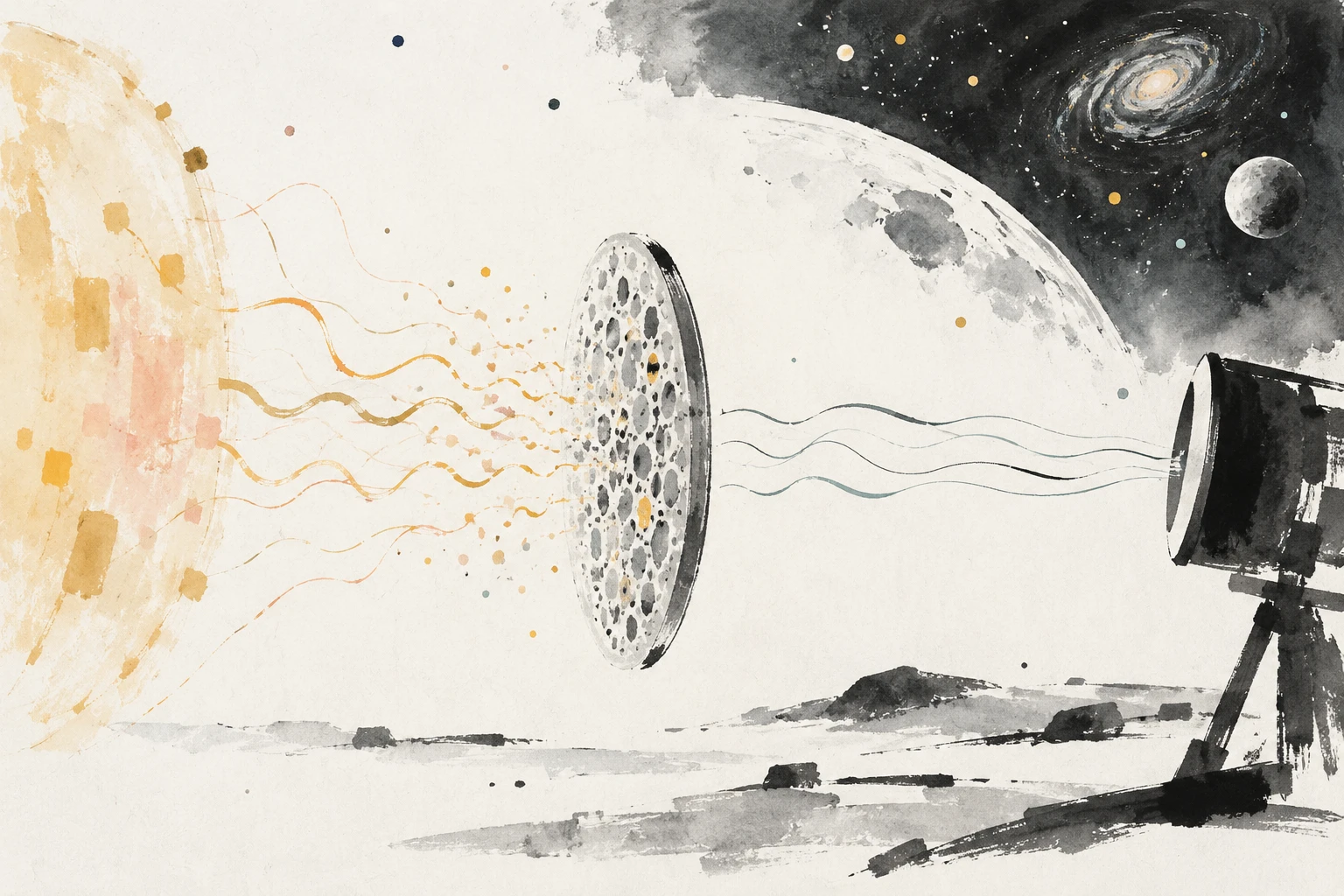
In a cryogenic telescope receiver, heat is not merely wasted energy. It is noise. Infrared light from warmer parts of the instrument can leak onto detectors cooled to within a few degrees of absolute zero, washing out the faint millimeter and submillimeter signals astronomers seek. The challenge is to block that glow without blocking the wavelengths that carry the science. A research team has now tested a filter that does this with an unexpected ingredient: microscopic diamonds suspended in a porous, foam-like plastic.
A Synthetic Fog That Lets Long Wavelengths Through
The material is a diamond-loaded polyimide aerogel. A polyimide is a polymer; an aerogel is a solid network so full of empty space that it is mostly pores. The resulting filter has a low refractive index, about 1.15, which means its surfaces reflect little light and it does not need antireflection coatings. Those coatings add fabrication steps and can peel off in the cold.
The diamonds are not there for hardness or sparkle. They scatter infrared light. By choosing the size and concentration of diamond particles, the researchers can tune where the filter stops transmitting, known as the cutoff. Larger particles push the cutoff to lower frequencies; smaller particles push it higher. Loading densities from 20 to 100 milligrams per cubic centimeter allow fine-tuning. The paper notes that densities much above 100 milligrams per cubic centimeter prevent the aerogel from polymerizing and curing properly.
The team measured total hemispherical transmittance and reflectance with a Bruker Fourier transform spectrometer and an integrating sphere, which collects light scattered in all directions rather than only along the beam. From those measurements they estimated emissivity, a measure of how efficiently the material radiates or absorbs heat, using the relation emissivity is approximately 1 minus transmittance minus reflectance.
Three Instruments, Three Different Jobs
The filters were designed and characterized for three very different experiments.
CLASS, the Cosmology Large Angular Scale Surveyor, is a ground-based cosmic microwave background polarimeter in Chile observing from 33 to 234 gigahertz. Its cryogenic receivers need large filters, around 40 centimeters across, and must reject infrared radiation from warmer stages by as much as one part in a million. The paper is clear that currently fielded CLASS instruments will not use aerogel scattering filters; instead, a spare receiver served as a testbed for future instruments.
EXCLAIM, the Experiment for Cryogenic Large-Aperture Intensity Mapping, is a balloon-borne mission planned to study star formation across cosmic time by measuring integrated line emission from carbon monoxide and ionized carbon. It is designed to observe between 420 and 540 gigahertz with a telescope colder than 5 kelvin. Two aerogel filters, each about 10 centimeters across, are planned. One would sit inside the evacuated receiver cryostat, while the other would operate within the helium boil-off gas of the dewar. The aerogel's open pores would let that cold gas permeate and cool the filter.
SSOLVE, the Sub-millimeter Solar Observation Lunar Volatiles Experiment, is a CubeSat mission concept to place a small satellite on the lunar surface. It would use the Sun as a backlight to search for absorption lines from HDO at 23 gigahertz, water at 533 gigahertz, and OH at 2.51 terahertz rising from the lunar regolith. Its filter must pass more than 90 percent of light at 2.5 terahertz—the paper's detailed target is above 94 percent up to 2.51 terahertz—while blocking more than 95 percent of the integrated solar luminosity. Three prototype formulations met or exceeded that in-band transmission requirement.
What Survived the Cold—and What Still Doesn’t Add Up
The researchers also pushed the material toward the conditions of a real receiver.
They fabricated large films more than 50 centimeters wide. Three production methods were compared. The vertical mold kept small and large diamond particles mixed more evenly. The horizontal mold and the casting table let larger particles settle downward. The doctor blade produced more uniform thickness, but it did not prevent that settling.
Prototypes survived repeated thermal shock and cycling down to 4 kelvin with no degradation in mechanical properties. In the CLASS 90-gigahertz receiver, several filter stacks were tested: three or five aerogel filters, with and without foam filters on the room-temperature stage. Thermal simulations with COMSOL Multiphysics, which modeled both radiation and conduction, best matched the measured temperatures when the filter emissivity was between 0.15 and 0.20. A five-filter stack would satisfy the CLASS receiver's load requirement if adopted.
The agreement is encouraging but not complete. The 4-kelvin baseplate loads inferred from the receiver tests were higher than the power emitted by the bottom 4 K filter in the COMSOL simulations. The authors suggest possible explanations: thermal load might reach the baseplates through gaps between shields rather than through the filters, or tiny air bubbles in the aerogel might make it slightly more transmissive than optical measurements suggest. One thermometer on a top 4-kelvin filter in the five-filter configurations may also have been faulty.
The simulations assume the filters are perfect diffusers that transmit, radiate, and reflect uniformly. The emissivity estimated from optical measurements is an average across wavelengths. These differences mean the thermal picture is still being refined.
This work is reported in an arXiv preprint and describes prototypes, simulations, and planned applications. It does not demonstrate a finished flight instrument. CLASS's current instruments do not use them; EXCLAIM is upcoming; SSOLVE is a mission concept. The emissivity range of 0.15 to 0.20 is an estimate.
Even so, the approach turns a familiar material into a precision tool. The universe's faintest signals often arrive as long-wavelength light, and protecting them means keeping heat out. In this design, diamonds become microscopic scatterers suspended in a synthetic fog, helping the coldest parts of a telescope stay quiet enough to listen.