
JWST Maps a Gravitational Lens Galaxy’s Stellar Motions from Space for the First Time
New JWST-NIRSpec observations map how stars move inside the lens galaxy RXJ1131-1231, a step toward breaking a key degeneracy in time-delay measurements of the Hubble constant.
Jun 26, 2025
The quasar that arrives four times
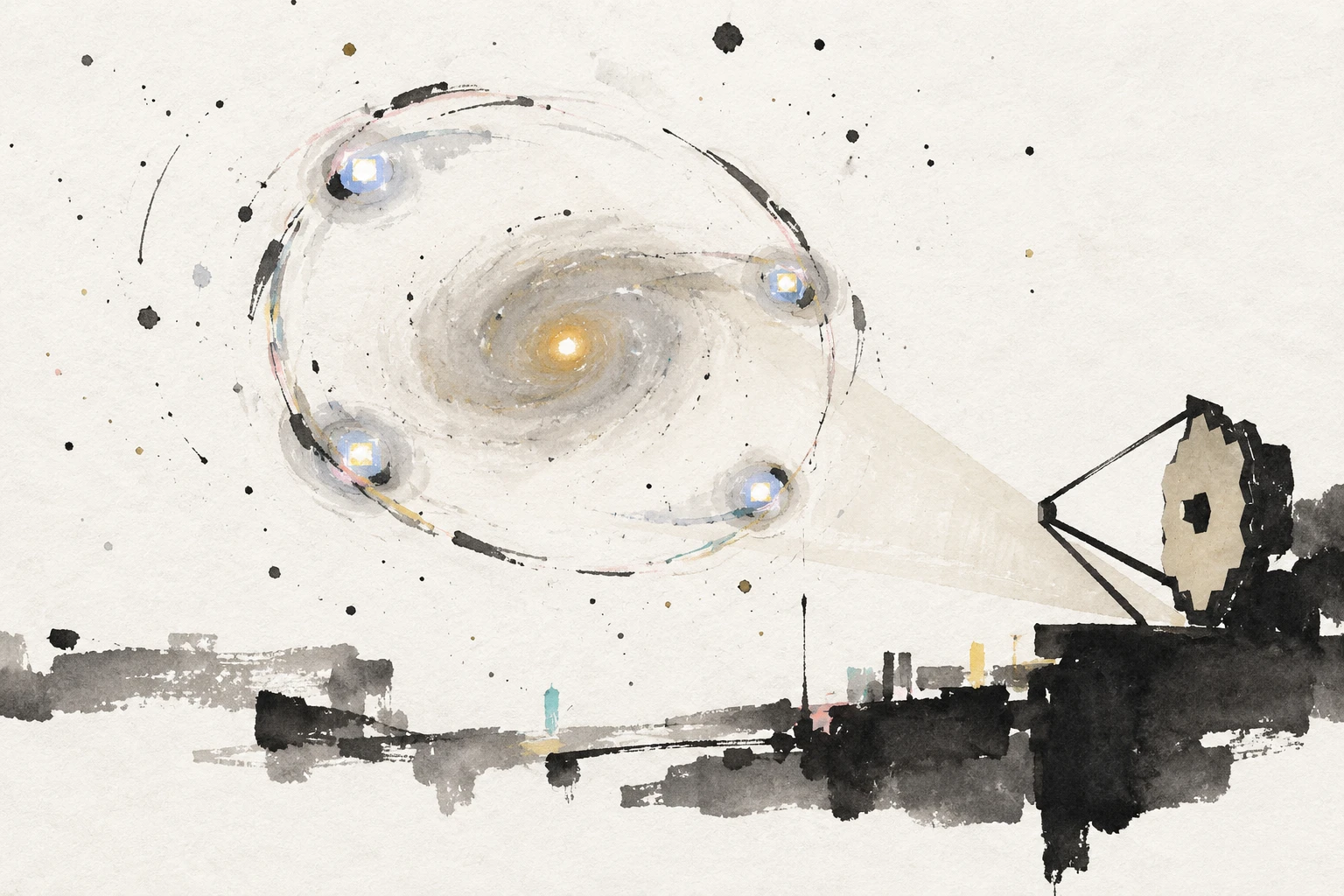
RXJ1131-1231 is a cosmic optical illusion. A distant quasar—a brilliant, feeding black hole—sits behind an elliptical galaxy. The galaxy’s gravity bends the quasar’s light into four images and an Einstein ring of arcs from the quasar’s host galaxy. The lens galaxy lies at redshift 0.295, the quasar at 0.654. Redshift measures how much cosmic expansion has stretched their light.
For cosmologists, this system is a tool. When the quasar flickers, light travels along different paths around the lens galaxy and arrives at slightly different times. Those delays depend on distances and the expansion rate, offering an independent way to measure the Hubble constant, the present-day expansion rate.
The catch is mass. To turn time delays into a Hubble constant, astronomers must know how mass is arranged in the lens galaxy. Different mass profiles plus a uniform sheet of extra mass can produce nearly the same lensing pattern while changing the inferred expansion rate. This is the mass-sheet degeneracy. Stellar motions offer an independent way to break it.
Why a galaxy’s stars can weigh in on cosmic expansion
The TDCOSMO collaboration has spent years using gravitational lenses for time-delay cosmography. Earlier measurements reached a few percent precision, but only by assuming specific forms for the lens galaxy’s mass profile. When those assumptions were relaxed, the uncertainty grew. Better stellar kinematics are meant to reduce it again.
Anowar J. Shajib and colleagues used JWST’s Near-Infrared Spectrograph, or NIRSpec, in integral field spectroscopy mode. Instead of one spectrum of the whole galaxy, this mode takes a spectrum for each position across a small field. The result is a three-dimensional datacube: two dimensions of space and one of wavelength.
The team observed RXJ1131-1231 on May 9, 2023, targeting near-infrared wavelengths that include the calcium II triplet, absorption lines produced by stars in the lens galaxy. Those lines are a well-tested tracer of stellar motion in elliptical galaxies.
Pulling a faint galaxy spectrum out of the glare
The measurement was not simple. The lens galaxy’s faint absorption is buried under four bright quasar images and emission from the quasar’s host galaxy. To isolate it, the team jointly modeled all three components: the lens galaxy’s stars, the quasar’s emission lines, and the host galaxy’s stars and gas.
They also cleaned the data beyond the standard JWST pipeline. The spectra contained residual cosmic rays and a wavy resampling pattern called wiggles. The team developed a custom reduction pipeline, RegalJumper, and a kinematic-fitting pipeline, squirrel. Both are publicly released.
After cleaning, they combined pixels into 32 regions, or Voronoi bins, targeting enough signal in each to measure stellar motions; only the final bin, containing the satellite, falls slightly below the target. The bins let them build maps of velocity dispersion—the spread of stellar speeds along the line of sight—and mean velocity.
A slow rotator, mapped in 32 patches
The maps show a galaxy that rotates slowly. Mean line-of-sight velocities stay below about 50 kilometers per second, with no clear bipolar rotation. The lens is a slow rotator, consistent with earlier ground-based measurements.
The velocity dispersion map carries the cosmologically useful information. It shows how the random motions of stars change across the galaxy. Those motions respond to the total mass distribution, including dark matter, and can help distinguish between mass models that lensing alone cannot separate.
One bin contains a small satellite galaxy near the main deflector. The team treated it carefully because its light blends with the lens galaxy. They found no spectral features indicating a very different redshift, supporting the view that its redshift is very close to the main galaxy’s.
A sharper check on a ground-based result
Before this work, RXJ1131-1231 had been observed with the Keck Cosmic Web Imager, a ground-based integral field unit. That study provided the first spatially resolved kinematics for the system. The new JWST data have roughly six times better angular resolution, with a point-spread function about 0.15 arcseconds across.
The team compared the datasets by turning their 2D maps into one-dimensional radial profiles and fitting dynamical models. The JWST and Keck measurements are statistically consistent: a likelihood-ratio test gives a p-value of about 0.28, equivalent to roughly 1.1 sigma. That agreement is a cross-check, not a discrepancy.
The advantage of JWST appears in what it constrains. The sharper data narrow the allowed range for stellar anisotropy—how stellar motions are ordered, whether more radial or more tangential. Anisotropy can blur the link between observed stellar speeds and the underlying mass. Keck’s seeing-limited resolution left it largely unconstrained; JWST begins to pin it down.
What the map does—and does not—settle
This paper does not report a new Hubble constant. It presents kinematic measurements that a future study will combine with lens models, time delays, and an estimate of line-of-sight convergence to infer the expansion rate. Some 1D kinematics from the same NIRSpec dataset have already been used in a recent TDCOSMO Hubble constant measurement; the new 2D map is intended to go further.
The work has caveats. It analyzes one lens system. Dynamical modeling still assumes a model for the galaxy’s mass and stellar motions. The team estimates a 1.58% systematic covariance from choices such as stellar template libraries, and the satellite-containing bin is a blended measurement. The study is a preprint in the TDCOSMO series.
Still, the result is a first for JWST: a space-based stellar kinematic map of a time-delay lens galaxy. Astronomers have long known that the internal motions of lens galaxies could sharpen time-delay cosmography. With JWST, they can now measure those motions across a lens galaxy in the infrared, where the calcium triplet provides a clean stellar signal. The next step is to fold this map into the full cosmological model. If it performs as simulations suggest, it could help sharpen the Hubble constant measurement and clarify the Hubble tension—the disagreement between early- and late-universe measurements of the expansion rate—or show where the uncertainty truly lies.