
JWST Finds the Most Chemically Primitive Galaxy Yet—and It May Still Be Forming Its First Stars
Spectroscopy of gravitationally lensed LAP1-B reveals an ultra-faint galaxy with only about 0.4 percent of solar oxygen, an exceptionally hard ionizing field, and an elevated carbon-to-oxygen ratio that hint at an early, possibly Population III, stellar generation.
Jun 13, 2025
In a small patch of sky behind a massive galaxy cluster, the James Webb Space Telescope has picked out a galaxy so faint that it registers only through a few glowing emission lines. Its light left when the universe was about 800 million years old. But what makes the object—called LAP1-B—remarkable is not just its distance. Its gas is almost devoid of elements heavier than helium, making it the most chemically primitive star-forming galaxy yet identified, according to a new preprint.
The paper, led by Kimihiko Nakajima of Kanazawa University and the National Astronomical Observatory of Japan, was posted to arXiv on June 13, 2025. It has not yet completed peer review. The observations come from JWST's Near Infrared Spectrograph, or NIRSpec, which splits infrared light into a spectrum so astronomers can identify chemical fingerprints.
A Galaxy Faint Enough to Hide in Plain Sight
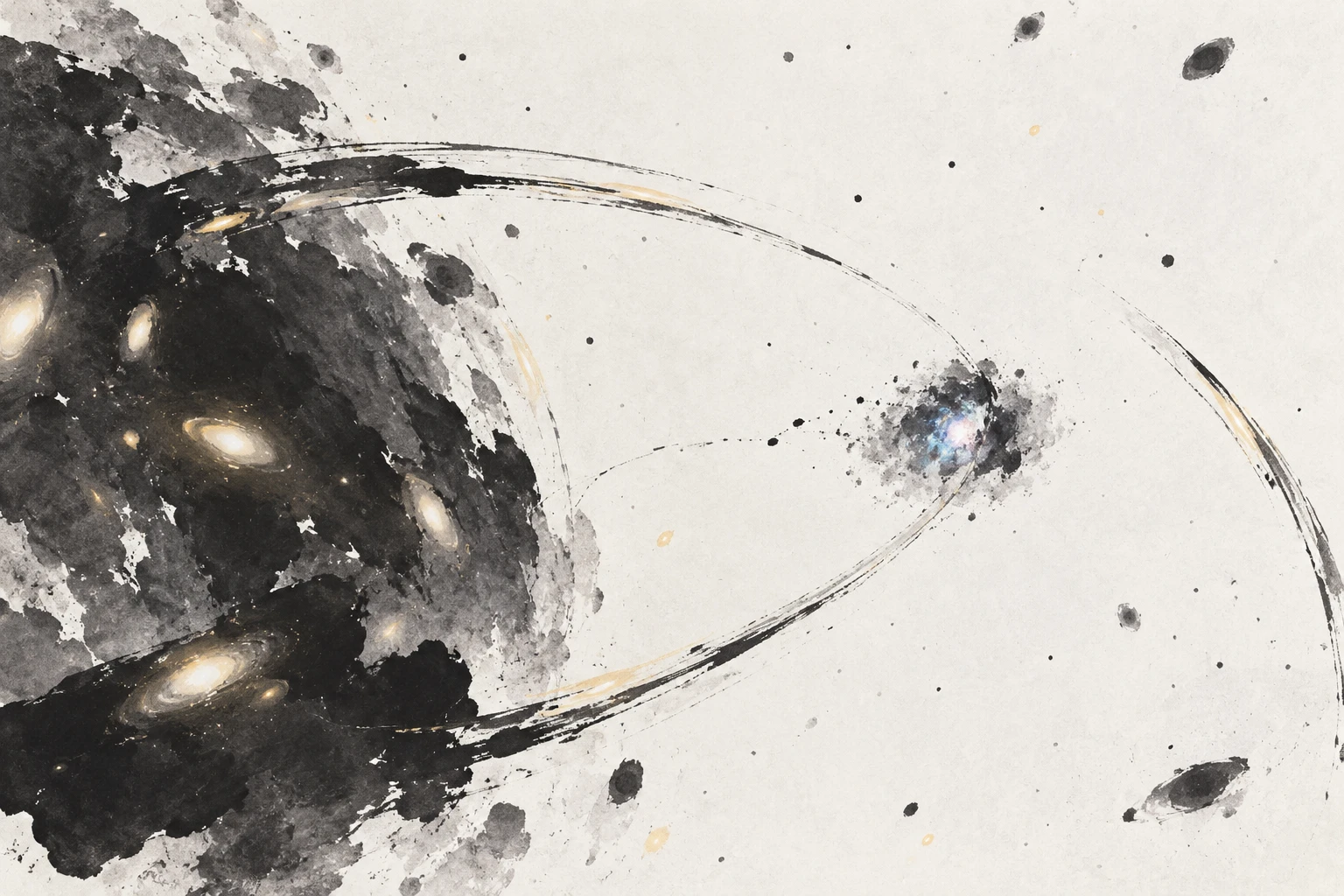
LAP1-B sits at redshift 6.625, a measure of cosmic distance and time. The paper's spectroscopy pins that redshift to within about 0.001. The galaxy lies behind the galaxy cluster MACS J0416, whose gravity acts as a lens, bending and magnifying the background galaxy's light. That magnification is why JWST can study a system that would otherwise be far too faint. Its rest-frame ultraviolet absolute magnitude is fainter than -10.4, making it ultra-faint by high-redshift standards.
The NIRSpec data reveal five significant emission lines: hydrogen-alpha and hydrogen-beta, one oxygen-ion line, one carbon-ion line, and Lyman-alpha. Emission lines are bright markers of ionized gas. They also allow astronomers to infer what kind of stars are heating that gas.
The Spectrum Says Almost No Metals—but Not None
In astronomy, metals are elements heavier than helium. LAP1-B's gas-phase oxygen abundance is about 4.2 x 10^-3 times the solar value, or roughly 0.4 percent of the Sun's oxygen-to-hydrogen ratio. That is below the roughly 2 percent solar metallicity floor that had marked the most metal-poor galaxies confirmed previously at redshifts 4–10. The measurement has sizable uncertainty: about plus or minus 1.8 x 10^-3 solar.
This does not mean LAP1-B is completely pristine. The spectrum does contain weak oxygen and carbon lines. That suggests the interstellar medium has been enriched by only a minimal number of stellar generations, likely including some early supernovae. The hydrogen line ratio H-alpha/H-beta is consistent with little or no dust, as expected in such a metal-poor environment.
A Hard Glow That Ordinary Stars Struggle to Explain
The more surprising signal is the shape of the ionizing radiation. Astronomers measure the ionizing photon production efficiency, a ratio comparing the number of hydrogen-ionizing photons with the galaxy's non-ionizing ultraviolet light. For LAP1-B, that efficiency is high: log (ξ_ion / erg^-1 Hz) > 26.1 at 3-sigma confidence. The hydrogen-alpha line is also extremely strong relative to any stellar continuum, with an equivalent width greater than 1800 angstroms at 3 sigma.
Those values are hard to reproduce with chemically enriched stellar populations or with accretion onto black holes, according to the paper's comparison with photoionization models. They fit better with theoretical spectra of massive stars that contain no metals at all—Population III stars, the predicted first generation born from primordial hydrogen and helium.
A second clue comes from the carbon-to-oxygen ratio. LAP1-B shows a C/O ratio about 1 to 2 times the solar value, even though its oxygen abundance is extremely low. At similar low oxygen abundances, Galactic metal-poor stars and damped Lyman-alpha systems define a lower C/O trend; LAP1-B sits above it. The paper argues that the elevated ratio matches nucleosynthesis from metal-free stars, especially if some massive Population III stars exploded as faint supernovae that ejected carbon-rich outer layers but failed to expel oxygen-rich inner layers. The authors are careful: the He II line that would be a key diagnostic of Population III stars is not securely detected. Its upper limit is consistent with such stars, but does not prove their presence.
Astronomers See a Dark Matter Halo, Not Just a Tiny Galaxy
The galaxy's mass budget is just as striking. Deep JWST imaging finds no detectable stellar continuum, which limits the stellar mass to less than about 2,700 solar masses at 3-sigma confidence. The gas mass is estimated at a few hundred thousand solar masses. Yet the hydrogen-alpha line is broader than the instrument alone would produce, implying internal motions of about 58 kilometers per second. Using that velocity dispersion and an estimated size of about 10 parsecs, the authors infer a dynamical mass of order 10 million solar masses.
That means the baryonic mass—stars and gas—makes up less than about 1 percent of the total. The rest is inferred dark matter. Such a dark-matter-dominated, gas-rich, tiny system resembles the ultra-faint dwarf galaxies that survive around the Milky Way today. LAP1-B may be a younger, still-forming version of one of those ancient relics, caught during the epoch of reionization while star formation was still ongoing, before reionization finished shutting down star formation in small halos.
The Case Is Strong, Not Closed
The result rests on spectra and models, not a direct image of primordial stars. The stellar mass is an upper limit. The dynamical mass depends on the assumed size and structure of the emitting gas. The oxygen abundance is derived from the [O III]/Hβ strong-line calibration extended into a regime where empirical calibrations are scarce, and the adopted ionization parameter is unusually high. The authors also assume that gravitational lensing magnifies the line-emitting gas and stellar continuum similarly. If it does not, the observed equivalent widths and ionizing-photon efficiency could be amplified.
Even with those caveats, LAP1-B occupies a rare place in the young universe. It is faint, chemically primitive, gas-rich, and apparently dominated by dark matter. It may be a galaxy in the act of forming its first stars—or shortly after the first supernovae from those stars. Either way, it offers a glimpse of the transition from a nearly pristine cosmos to the chemically enriched one we see today. For astronomers, the most intriguing possibility is that LAP1-B offers a rare window into the earliest stages of galaxy formation.