
JWST Weighs a Quiet 6-Billion-Solar-Mass Black Hole—and Finds a Bulge Problem
JWST and gravitational lensing have produced the first stellar-dynamical mass for an inactive supermassive black hole at redshift 1.95, finding about 6 billion solar masses and evidence that black-hole–bulge scaling has evolved substantially while the black-hole–velocity-dispersion relation may have been in place for about 10 billion years.
Mar 21, 2025
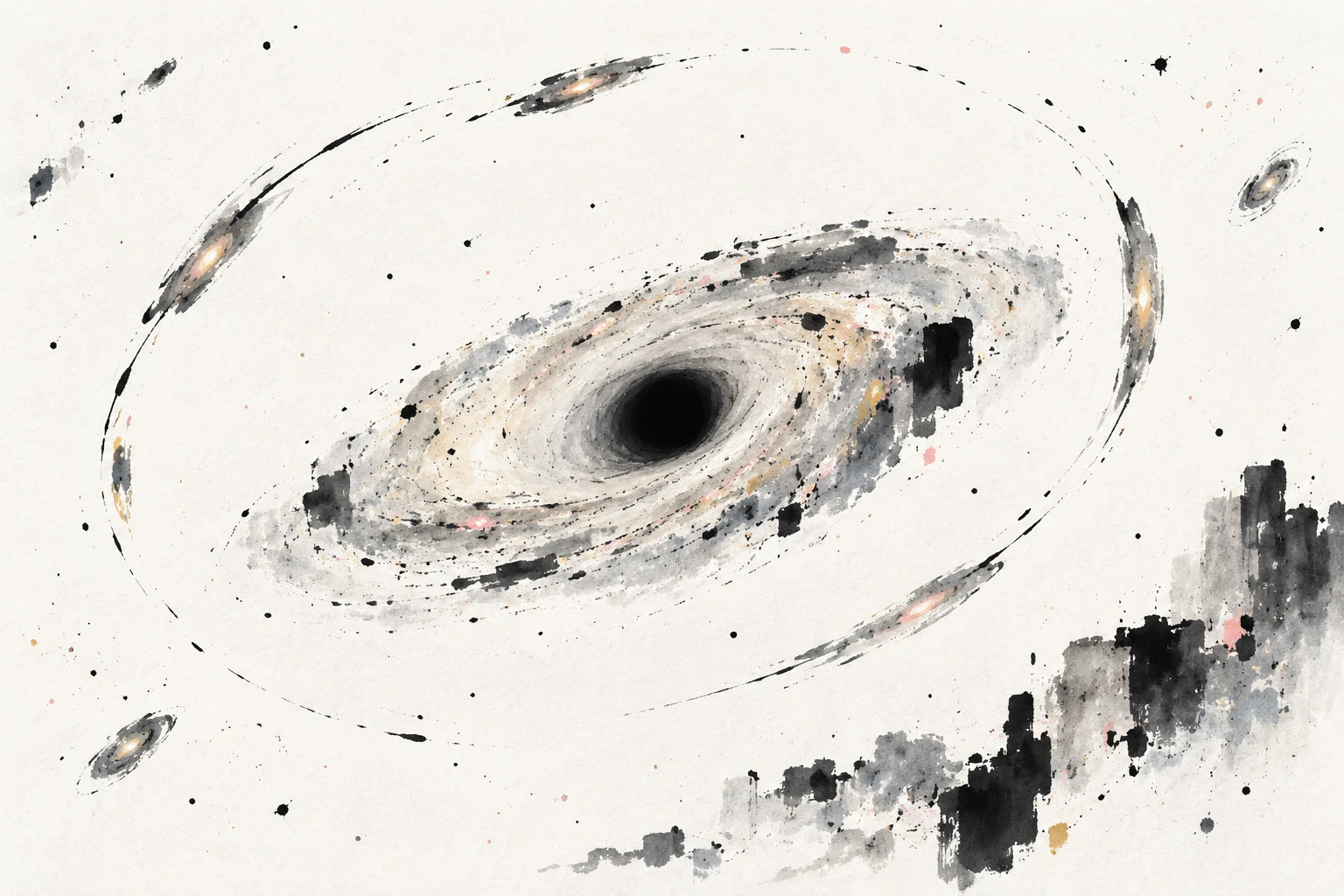
Some 10 billion years ago, a galaxy called MRG-M0138 already held a supermassive black hole that was both enormous and quiet. The galaxy sits at redshift 1.95, so its light has traveled through an expanding universe for roughly 10 billion years. A foreground galaxy cluster, MACS J0138.0–2155, bends that light into several magnified images, making the distant galaxy about 29 times brighter and larger than it would otherwise appear.
That natural magnifying glass is what made the new measurement possible. Astronomers used the James Webb Space Telescope's NIRSpec integral field unit, an instrument that takes a spectrum at many positions across a small patch of sky. Over two grating settings, it collected spectra in 219 spatial bins across one lensed image of MRG-M0138. The goal was not to see the black hole itself. It was to watch how stars move around it.
An Invisible Weight in Starlight
Stars in a galaxy orbit in the combined gravity of everything present: stars, gas, dark matter, and any central black hole. Near the center, a massive black hole can make stars move faster in random directions. That random motion shows up as a broadening of absorption lines in a galaxy's spectrum, called velocity dispersion.
MRG-M0138 is a quiescent galaxy, meaning it has largely stopped forming new stars. It is massive, old, and relatively dust-poor, which makes its stellar absorption lines easier to interpret. Gravitational lensing sharpened the view further, giving an effective spatial resolution of about 91 parsecs at the galaxy center.
The team combined the spectra with Hubble and JWST images, mapped the galaxy's stellar velocity and velocity dispersion, and then modeled the gravity using a technique called Jeans anisotropic modeling, a way to infer the mass distribution from stellar motions. The models compared the observed stellar motions with the pull of the visible stars, dark matter, and a central black hole. A model without a black hole could not reproduce the sharp central peak in the stars' root-mean-square velocity. The best models instead required a black hole of about 6.0 billion solar masses. The black hole's sphere of influence—the region where its gravity dominates stellar motions—has a radius of about 164 parsecs and is resolved at about 1.8 times the telescope's effective resolution.
A Giant That Is Not Eating Much
This is not a quasar. MRG-M0138's nuclear spectrum shows only faint emission lines with ratios typical of a low-ionization nuclear emission region, or LINER—a class of faint emission from weakly ionized gas. From an upper limit on hydrogen-alpha emission, the team estimates an Eddington ratio below about 10^{-5.1}. The Eddington ratio compares a black hole's actual luminosity with the maximum it could sustain; such a low value means the black hole is accreting very inefficiently. A Chandra X-ray non-detection points the same way.
So the object is an inactive black hole—and an unusually massive one. Its mass rivals the engines of rare, luminous quasars, but it was found in a quiescent galaxy rather than selected because it blazes as an active nucleus. That matters because distant black-hole masses have mostly come from active systems, where astronomers infer mass from gas moving in the broad-line region. Those estimates rely on unresolved spectra and assumptions about the broad-line region's size and structure, leaving uncertainties that can reach an order of magnitude.
A Bulge That Lags Behind
The new mass lets astronomers place MRG-M0138 on the local scaling relations that link black holes to their host galaxies. One relation connects black-hole mass to the bulge's stellar mass—the mass of the central concentration of stars called a bulge. The other connects black-hole mass to stellar velocity dispersion.
MRG-M0138 lies on the local black-hole–velocity-dispersion relation. That hints that this relation may have been in place for about 10 billion years, perhaps reflecting a fundamental link between black-hole growth and host-galaxy density, as indicated by the galaxy's high velocity dispersion. The result is based on one object and needs larger samples, but a weak or absent evolution would be a strong constraint on models of black-hole growth.
The black-hole–bulge relation tells a different story. MRG-M0138 is an outlier: its black hole is too massive relative to its bulge mass. Its black-hole-to-total-stellar-mass ratio is about 0.024, an order of magnitude higher than the average for coeval faint active galactic nuclei and among the highest ratios seen in local galaxies. Cosmological simulations rarely produce such a combination. In the ASTRID simulation, only 2 of 635 galaxies at redshift 2 with similar stellar mass contain a black hole as massive. The TRINITY model places MRG-M0138 a factor of five above the median black-hole–stellar-mass relation at that epoch, a 2–3 sigma outlier.
The contrast makes physical sense if bulges assemble later. Many stars in today's massive ellipticals may not have been in bulges during the main period of black-hole growth. Early quiescent galaxies often show disk-like morphologies and rotation, as MRG-M0138 does. Its black hole may have grown efficiently before mergers redistributed stars into a final bulge.
The paper suggests MRG-M0138 is on an evolutionary path toward a massive elliptical galaxy. If its later mergers are gas-poor, its black hole should grow little, its velocity dispersion should change little, and it could move onto the local black-hole–bulge relation while remaining on the black-hole–velocity-dispersion relation. Its final black hole and stellar masses could resemble those of M87. Local relic galaxies, which look like undisturbed survivors of early quiescent systems, share its rapid rotation and high central velocity dispersion, supporting that picture.
The caveats are important. This is a single galaxy. The measured mass depends on the gravitational lensing magnification, which is the largest systematic uncertainty. The dynamical models also depend on modeling choices for the stellar initial mass function—the assumed distribution of stellar masses—dark matter, and the stars' orbital anisotropy. The work is an arXiv preprint, and the paper says the measurement must be verified using larger samples.
Still, MRG-M0138 offers a rare glimpse of the quiet majority of massive black holes in the distant universe. It shows that a black hole can grow to billions of solar masses, then fade into near silence, while its galaxy is still assembling the bulge it will one day call home.