
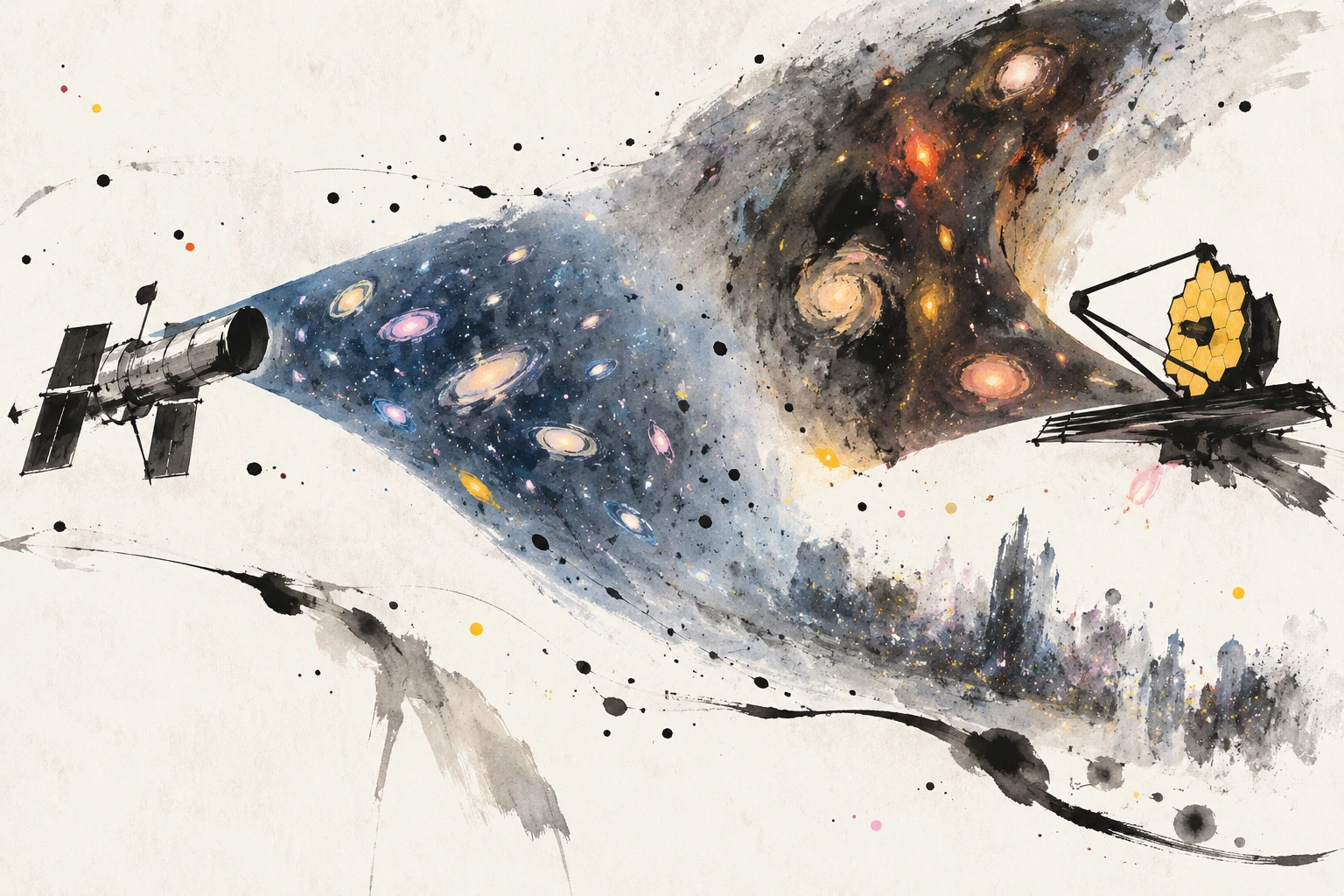
Why Hubble Still Matters: The Ultraviolet View JWST Cannot Replace
A new arXiv preprint argues that Hubble's ultraviolet and blue-light images capture the rest-frame UV view of at least half of all stars, a view JWST cannot replace, making continued Hubble imaging essential for galaxy science.
Oct 2, 2024
The Hubble Ultra Deep Field, or HUDF, is the patch of sky at the center of a new arXiv preprint. Astronomers led by Rogier Windhorst of Arizona State University ask a practical question: if JWST is newer and built for infrared light, why keep Hubble running? Their answer is not nostalgia. It is wavelength.
The paper, posted on arXiv on October 2, 2024, focuses on galaxy science. It is an arXiv preprint.
A 556.3-Hour Hubble Stack Meets 52.7 Hours of JWST
The comparison uses public data. The team rendered 556.3 hours of Hubble images of the HUDF taken through 12 filters. It contrasted those with 52.7 publicly available hours of JWST NIRCam images of the same area from the JADES survey, taken through 8 filters. The paper notes that this 52.7-hour figure was obtained by multiplying the actual JWST observing hours by 2, to represent the total exposure time in each of the simultaneously exposed NIRCam short- and long-wavelength filter pairs.
The authors also combine 361.3 hours of Hubble ultraviolet and optical data with the 52.7 hours of JWST near-infrared data. At a total of 414 hours, they describe it as the deepest combined HST+JWST color image available from public data to date. A second example combines 122-hour Hubble Frontier Field images with 3-epoch 22-hour JWST PEARLS NIRCam images of the galaxy cluster MACS0416 at redshift z=0.397.
Redshift, written z, measures how much cosmic expansion has stretched a galaxy's light; higher redshift means earlier in cosmic history. This is not a new detection of a single object. It is an argument built from images, exposure times, and the physics of starlight.
Hubble's Blue Channel vs. JWST's Redder Channels
Hubble was designed for about 0.1–1.6 micrometers, from ultraviolet through near-infrared. JWST covers about 0.9–28 micrometers, mainly infrared. They overlap, but Hubble owns the shorter wavelengths. That matters because young, hot, massive stars shine brightly in the rest-frame ultraviolet. Rest-frame means the wavelengths the galaxy actually emitted before cosmic expansion stretched them. For galaxies at redshifts below about 2, that ultraviolet light lands in Hubble's ultraviolet and blue-optical range. The paper notes that JWST does not sample wavelengths below about 0.8–1.0 micrometers close to its diffraction limit—the sharpness limit set by a telescope's aperture and wavelength. JWST's shortest NIRCam filters begin near 0.9 micrometers.
Hubble therefore traces unobscured young stars and accretion disks around growing supermassive black holes in an era when much of the universe's star formation was happening. The paper notes that cosmic star formation started at redshifts above roughly 10–13, when the universe was less than 300–500 million years old, but did not peak until redshift about 1.9, about 10 billion years ago, and has declined since. At least half of all stars in the universe formed in the era Hubble's ultraviolet view covers best.
In the color images, Hubble's blue channel lifts out clumpy recent star formation and faint blue dwarf galaxies. JWST's green and red channels bring forward old elliptical galaxies at redshifts above about 1, dust-obscured objects, weak central active galactic nuclei (AGN, powered by material falling onto supermassive black holes), and rare high-redshift sources at redshifts around 10–13 and above. In the combined image, the two telescopes do not compete; they complement each other.
The paper also turns to gravitational lensing, where massive galaxy clusters act as cosmic magnifiers. In a caustic transit, a cluster's gravity briefly boosts an individual star at cosmological distance. Hubble has been essential for finding blue supergiants in these events, while JWST is better suited to their red supergiant companions and to the highest redshifts. One example, the star Earendel at redshift 6.2, was found with Hubble and later studied with JWST.
The 6.85 Ratio, MACS0416, and the Case for Keeping Hubble
The paper is careful about the comparison's limits. It uses public data, not a new controlled survey. The color images are renderings: the authors assign Hubble's bluest filters to blue, JWST's short-wavelength NIRCam filters to green, and JWST's long-wavelength NIRCam filters to red. In the combined Hubble-plus-JWST image, they leave out Hubble's WFC3 infrared images because those have lower spatial resolution and are not as deep as the JWST NIRCam data.
The exposure-time ratio is striking: about 361.3 Hubble hours versus 52.7 JWST hours, a factor of 6.85. That is similar to the ratio of the two telescopes' collecting areas—the total light-gathering area of their mirrors—so in the narrow wavelength range where they overlap, the paper says the images reach comparable depths for isolated flat-spectrum point sources. The paper presents this as an assessment of complementary capabilities, not a claim that either telescope can do everything.
Using full cost accounting, the paper says Hubble will have cost over $20 billion since the early 1970s, including all six shuttle missions, and JWST over $10 billion since the mid-1990s. To maximize return on both investments, the authors argue, Hubble's imaging instruments should keep operating in all relevant modes for as long as possible. Their priority list includes WFC3/UVIS, the ultraviolet-visible camera, for UV and blue imaging, and ACS/WFC, Hubble's wide-field optical channel, for high-resolution optical imaging, polarimetry (measuring polarized light), ramp filters (which isolate narrow wavelength ranges), and efficient parallel observations (where instruments observe different fields at once).
The paper also considers future missions: ESA's Euclid, the Nancy Grace Roman Space Telescope, and China's Space Station Telescope (CSST). Euclid and Roman will map large areas but lack Hubble's unique filters between 0.2 and 0.6 micrometers. CSST will cover some ultraviolet-optical wavelengths over wide fields but with much coarser angular resolution. The paper argues none can simply replace Hubble.
Hubble cannot do everything. It cannot see the dustiest galaxies or the earliest objects as JWST can. The reverse is also true: JWST cannot replace Hubble's view of the unobscured young stars that trace so much of cosmic star formation. The deepest combined HST+JWST color image in the paper is not one telescope's portrait. It is a layered record, painted in wavelengths from ultraviolet to infrared. Hubble supplies the blue brush; JWST supplies the infrared one. The paper's message is that both are needed: Hubble supplies the blue/ultraviolet view, JWST the infrared one, and together they cover a broader stretch of galaxy history.