
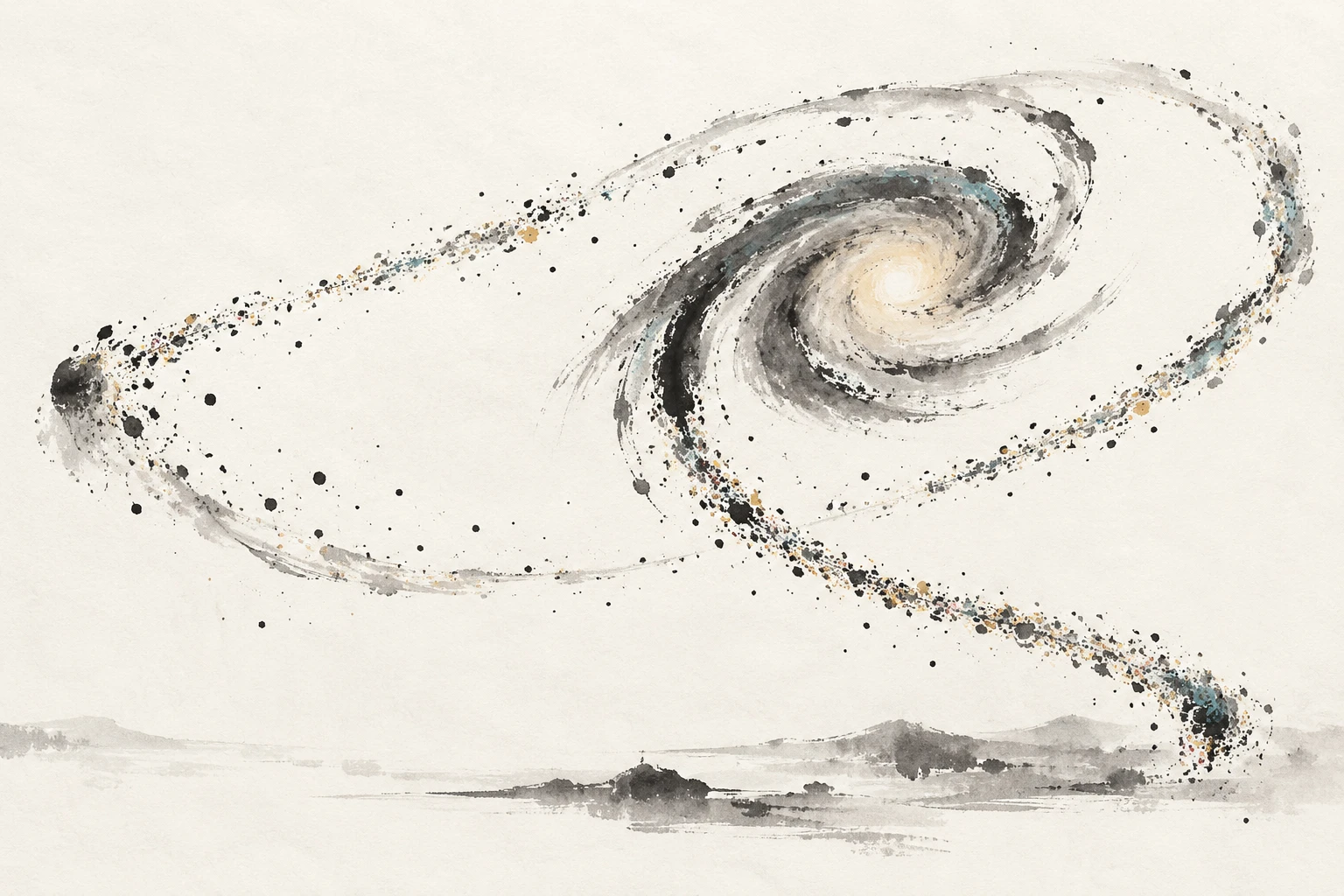
The Milky Way's Sagittarius Stream Is a 6D Puzzle—and Gas May Be the Missing Piece
A new N-body simulation reproduces the Sagittarius stream's core, arms, and bifurcations without needing a massive Large Magellanic Cloud, but its failure to match the arms' energy-angular-momentum relation may point to gas missing from current models.
Apr 18, 2022
About 26.5 kiloparsecs from the Sun—roughly 86,000 light-years—a small galaxy called Sagittarius is coming apart. The Milky Way's gravity has pulled its stars into a vast ribbon that wraps around the galactic center. Astronomers call it the Sagittarius stream, and it is one of the best natural laboratories for watching gravity at work on a galactic scale.
The stream is also a fossil. Its stars preserve clues about how the Sagittarius dwarf galaxy orbits and how the Milky Way's invisible dark matter halo shapes the debris. But reading those clues requires reconstructing the stream in six dimensions: three dimensions of position in space, plus three dimensions of velocity. That full portrait has been difficult to reproduce.
A new study, posted as a preprint on arXiv in April 2022, takes on that challenge with a computer simulation. It successfully rebuilds the stream's broad shape and several of its motions. Then it runs into a sharper problem—one that may require adding a component that all existing models have left out entirely: gas.
The Trouble With a Six-Dimensional Portrait
The Sagittarius dwarf spheroidal galaxy is the third most massive system surrounding the Milky Way. Its stars form a core, a leading arm ahead of the core in its orbit, and a trailing arm behind it. Recent work has also found that the arms split into two parallel branches, called bifurcations.
Previous models have matched parts of this picture. Some reproduced the overall sky distribution. Others matched proper motions, the sideways drift of stars across the sky, or line-of-sight velocities. But none captured the whole six-dimensional phase space. One model by Vasiliev and collaborators required a massive Large Magellanic Cloud—about 1.3×10^11 solar masses—to match the proper motions. Another model reproduced a leading-arm bifurcation by starting Sagittarius as a rotating disk, but it predated precise Gaia proper motions.
The new work asks whether a single N-body simulation can do better. An N-body simulation is a computer model that tracks how many particles move under one another's gravity. Here the researchers used the GIZMO code with a Milky Way mass of 5.2×10^11 solar masses and a Sagittarius mass of 9.3×10^8 solar masses. The Milky Way was represented by 1.2 million particles; Sagittarius by 180,000. The best match to observations came after 4.65 billion years, when Sagittarius was on a third passage around the Milky Way.
A Simulation That Gets the Shape Right
The team compared its simulation with real stars: about 55,000 red giant branch stars from the Vasiliev et al. catalog, including roughly 4,500 with line-of-sight velocities, plus RR Lyrae stars from Gaia DR2 and the Pan-STARRS1 survey. RR Lyrae are pulsating stars useful as distance markers.
The simulation reproduced the core, the leading and trailing arms, and bifurcations in both arms. That is notable because bifurcations have been a stubborn test. The southern bifurcation matched well: observations show the two sub-streams separated by 8 ± 3 degrees, while the model gives 7.2 ± 3.9 degrees. In the north, the observed separation is 6 ± 1.4 degrees, but the model's branches are narrower, at 3.1 ± 2.6 degrees. The authors say the southern feature is fully reproduced and the northern one is predicted qualitatively, needing fine-tuning.
The model also qualitatively reproduced the reported 3D motions of the stream without requiring a massive Large Magellanic Cloud. The authors emphasize that this does not rule out a massive LMC; it simply means their model does not need one. In the earlier Vasiliev et al. model, the required LMC mass was associated with a Milky Way mass near 5.6×10^11 solar masses within 100 kpc.
The Energy Split That Won't Fit
The most important mismatch appears in a different plane: energy versus angular momentum. Energy and angular momentum are useful quantities for describing how orbits are arranged.
Observations show that the trailing arm has higher energy than the leading arm at a given angular momentum. The model also predicts a more energetic trailing arm, but for the wrong reason: in the simulation, the two arms follow the same energy-angular-momentum relation, with the trailing arm made of high-energy, high-angular-momentum particles and the leading arm of low-energy, low-angular-momentum particles.
That disagreement is the paper's central puzzle. The authors suggest it may come from a missing ingredient: gas in the Sagittarius progenitor. Gas can interact with the Milky Way's hot halo through ram-pressure stripping, a headwind-like pressure as the galaxy moves through that halo. That process acts like a frictional force and can change energy and angular momentum, something gravity-only models cannot do.
There are reasons to think Sagittarius was once gas-rich. Irregular dwarf galaxies in that mass range are typically gas-rich when they orbit more than 300 kpc from the Milky Way and M31. Astronomers have also found possible gas relics associated with Sagittarius and evidence for relatively recent star formation in its core and stream. But the gas explanation remains a hypothesis, not a demonstrated solution.
What the Stream Still Cannot Tell Us
The study does not strongly constrain the initial mass of Sagittarius. The authors note that different models span a wide range of masses, so present modeling of the Sgr stream is far from being able to predict mass. The simulation also shows offsets in line-of-sight velocities at some longitudes, and data selection effects may make the observed stream look different from the model in places.
Still, the work marks a step forward. It produces a single model that captures the core, both arms, both bifurcations, and much of the observed motion. And it identifies a specific failure that may point beyond gravity alone.
If the authors are right, the stream's puzzling energy-angular-momentum behavior may reflect gas that was stripped away as the dwarf galaxy fell through the Milky Way's halo. The next generation of models may need to include gas in the Sagittarius progenitor—and perhaps also consider a massive LMC—to improve the stream's six-dimensional reconstruction.