
The Faintest Stellar Halos Could Help Probe Dark Matter’s Nature
A 2021 simulation study predicts that nearly invisible stellar halos around dwarf galaxies could help disentangle warm dark matter from a high galaxy-formation threshold—and constrain the mass threshold for small galaxies to form stars.
Oct 11, 2021
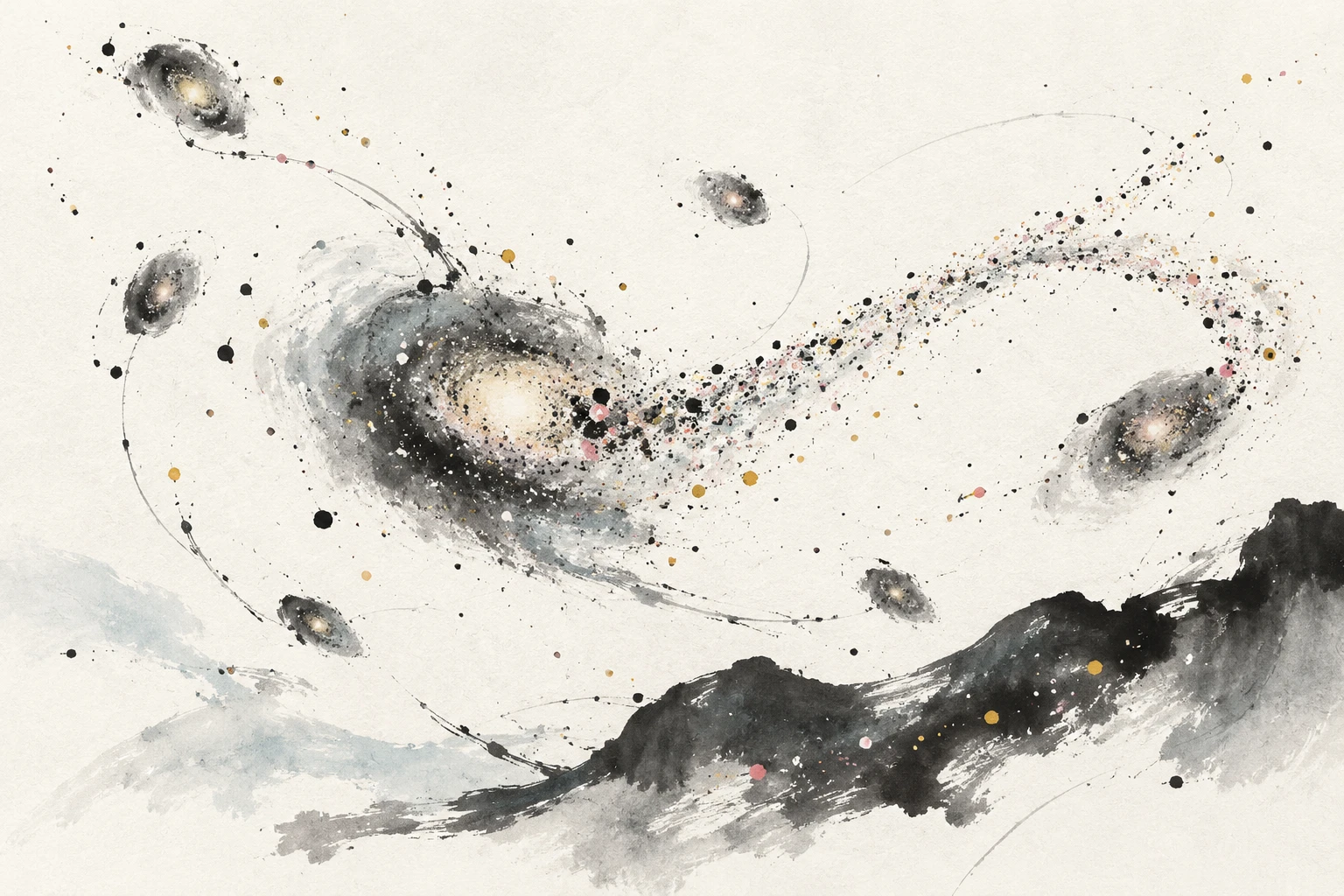
Astronomers know the Milky Way is wrapped in a diffuse stellar halo—a sparse cloud of stars torn from smaller galaxies and stretched into streams. The halo holds only about 1% of the Milky Way's stellar mass, but it records the galaxy's assembly. For dwarf galaxies, the question is much less settled: Do they have stellar haloes at all?
That question is the focus of a 2021 simulation study posted to arXiv by Alis Deason and colleagues. The team used cosmological simulations and empirical galaxy models to follow dark matter haloes about 10 billion times the Sun's mass—the scale of dwarf galaxies like the Milky Way's Fornax satellite. They asked which mergers bring stars into a dwarf's outskirts, and how that changes with dark matter and small-scale galaxy formation. This is a prediction, not a detection.
Galaxies grow hierarchically: dark matter haloes merge, and the galaxies inside them can be destroyed, adding their stars to a central galaxy. For Milky Way-mass galaxies, this builds an extended stellar halo. At dwarf scales, mergers are less common, the stellar mass-halo mass relation is uncertain, and not every dark matter halo may host a galaxy. The mass threshold for galaxy formation, and the epoch of reionization—when early light heated gas and suppressed star formation in small haloes—remain debated.
Warm dark matter thins the merger ranks
The team used the Copernicus Complexio simulations, which follow dark matter only, in both cold dark matter (CDM) and a warm dark matter (WDM) model with 3.3 keV particles. They tracked dwarf-mass haloes with peak masses around 10 billion solar masses over cosmic time and counted major and minor mergers.
In cold dark matter, a typical halo experiences about 1.6 major mergers and 7 minor mergers. In warm dark matter, those numbers fall to about 0.6 major and 2 minor mergers. Minor mergers are greatly suppressed because WDM particles stream away from small density fluctuations, smoothing out low-mass structures.
But whether dark matter mergers bring stars depends on galaxy formation. If galaxy formation requires a relatively high halo mass—about 10^9.3 solar masses at present—then most minor mergers are “dark”: the merging clumps never formed significant stars. Minor stellar mergers drop by roughly a factor of 7 to 16 compared with a model where all haloes host galaxies. If the threshold is lower, about 10^7.5 solar masses, minor mergers are common and can dominate the number of stellar accretion events.
That means a dwarf stellar halo is not just a detail. Its presence or absence could help separate warm dark matter from a high galaxy-formation threshold. Both can reduce minor mergers, creating a degeneracy that will likely require multiple lines of evidence to break.
The 1:5 sweet spot for a dwarf halo
The team also ran isolated simulations of dwarf-dwarf mergers, assigning stars to the most bound dark matter particles so the model galaxies roughly match observed dwarf sizes. They measured how much stellar material ended up beyond about 0.1 of the halo's virial radius—the distant, diffuse region that would count as a stellar halo.
Major mergers, around 1:2 in dark matter mass, bring in many stars but have high binding energy, so the debris stays relatively close to the center. Minor mergers, around 1:10, are less tightly bound and can fling material far out, but they bring few stars. The largest distant stellar haloes come from “intermediate” mergers, roughly 1:5. Models with a shallower stellar mass-halo mass relation also predict more stars in the outer halo.
The simulations suggest another observable difference. Dwarf galaxies that are satellites of a larger host, like the Milky Way, assemble differently from isolated field dwarfs of the same peak mass. Satellites tend to reach their peak mass earlier, so more of their mergers happen at higher redshift. In high-threshold models, present-day satellites have more stellar mergers—especially minor ones—than central dwarfs. In low-threshold models, the difference is smaller. Comparing satellite and field dwarf haloes could therefore help identify the galaxy-formation model.
Streams may be the best hunting ground
Detecting these haloes will be hard. The predicted surface brightness is incredibly faint, and an individual dwarf's stellar halo would likely be undetectable. Stacking many dwarfs could help, but only a model with a low galaxy-formation threshold and a shallow stellar mass-halo mass relation would likely produce a signal detectable by the Vera Rubin Observatory's Legacy Survey of Space and Time. Cold tidal features such as streams and shells would be brighter than the smooth average profile.
A more promising route may be the Milky Way. When a dwarf with its own stellar halo falls into a Milky Way-mass halo, the outer debris is stripped after a few billion years while the central dwarf survives. The stripped stars form a stream that can intersect the surviving dwarf in both position and velocity—phase space. Unlike satellites of satellites, which quickly lose coherence, these dwarf stellar haloes can remain linked to their parent for billions of years. The authors suggest that streams in the Milky Way halo overlapping in phase space with known dwarf satellites are likely remnants of their stripped stellar haloes. A diffuse, low-metallicity component linked to the disrupting Sagittarius dwarf may be one example. Gaia and surveys such as DESI, WEAVE, and 4MOST could test the idea.
The caveats are substantial. The isolated merger simulations ignore gas, so they likely underestimate how much material gas-rich major mergers can spread outward. They use a fixed present-day halo rather than realistic growth, and the particle-tagging method is approximate. The empirical galaxy models are illustrative, not definitive, and halo-to-halo scatter is large. This is a set of predictions for observers, not a detection.
Still, the message is clear: dwarf stellar haloes are faint, difficult, and worth hunting. If they exist—and if their streams can be found around known Milky Way dwarfs—they could help constrain the mass threshold for small galaxies to form stars and the nature of the dark matter particle. The smallest galaxies may leave the faintest, most revealing debris.